Author: Jill McCauslin (Page 15 of 23)

Breakfast Smoothie Recipe Veggie Challenge

I’ve been making a breakfast smoothie frequently for the past few months. I seem to go in cycles on smoothies. At times, they’re great and I enjoy having them. They satisfy me until lunch time and I have control over what I eat.

Because I add the frozen berries and the pomegranate juice, this smoothie is not green. It can turn a pinkish color, though sometimes it’s not an appetizing color. If that happens, serve it in a mug.

Here’s the recipe of what I’ve been doing lately. You can easily switch out the vegetables and fruit. Just use what you have on hand.

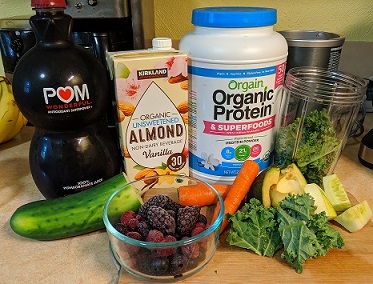
Breakfast Smoothie Ingredients

2 handfuls kale

1 chunk cucumber, skin  removed unless organic

1 carrot

1/2 avocado, peeled and seeded

2 to 3 handfuls frozen berries

1/4 cup pomegranate juice

1 cup almond milk

1 serving Orgain Organic Protein Powder, Vanilla Bean flavor

Throw all of the ingredients into a strong blender and blend. Follow your blender’s directions for the best order to put the ingredients.

This makes one generous serving or two moderate servings.

Notes

  • You can use whatever vegetables you have on hand though be careful if you use a vegetable with a strong flavor. For example, I find the taste of celery to be too distinctive to use in a smoothie.
  • If you don’t have any avocado, use some other source of fat. That might be a tablespoon of coconut oil or almond butter. Having the fat in the smoothie helps this feel like a complete meal.
  • You don’t have to use any juice in this. Besides the pomegranate juice, I love adding cranberry to the smoothie. I buy Just Cranberry. It’s made solely of cranberries. No other juices or sweeteners. It’s quite tart.
  • Adding some green or herbal tea, preferably room temperature or chilled, works well as a liquid.
  • I don’t add banana to this because the vanilla protein powder makes this sweet enough. If I wasn’t using the powder, I’d consider adding a banana for sweetness.
  • The frozen berries work well in the smoothie because they keep the drink cold. Of course, you can use fresh berries. Also, sometimes I use only blueberries or raspberries or strawberries. What you have on hand is the best choice.

breakfast smoothie


The Role of Discipline in Fitness

Chris and I talked about the role of discipline in fitness in our podcast episode 35 of Fit Strong Women Over 50, Inspiration, Motivation and Discipline. Chris said she didn’t like the word discipline because it makes her think of punishment. You know, being disciplined by the teacher was what she was thinking about.  I used the word as in being committed to something, as in having the discipline to do what is needed to achieve a goal.

I went to Dictionary.Com and looked for the definition of discipline. Here are the various definitions for the word:

Discipline

noun

training to act in accordance with rules; drill:military discipline.

activity, exercise, or a regimen that develops or improves a skill; training:A daily stint at the typewriter is excellent discipline for a writer.

punishment inflicted by way of correction and training.

the rigor or training effect of experience, adversity, etc.:the harsh discipline of poverty.

So, you can see that we were both right but just were thinking of different definitions.

When my son was younger, he played the bass in the school orchestra. He loved playing the bass and he played for many years. He went regularly to his lessons and never complained about going. However, he lacked the discipline to practice regularly so he never became as good as he could have.

His friend played the viola. He also took lessons but he practiced regularly and so he became a much stronger musician than my son. I don’t think he had more musical talent but I think he just worked harder. He was disciplined to practice daily and moved ahead in the school orchestra.

The same holds true for becoming fit. We talk about becoming like Elli, certainly a great goal, but we have to plan on how we’re going to actually do that. It takes some work for us to become fit and strong.

The first year that I ran a half marathon, I planned a training routine and I committed to it. I knew how often I needed to run each week and made the effort to do what I needed to do. I also made sure that I did my cross training. When I ran the race, it was great. I was happy with my results and I felt strong.

The next year I repeated the race but did not train as rigorously. I lacked the discipline for training that I needed. I finished the race, though in slower time than the year before, and quickly became injured.

The first part of this year was a challenge for me because I was still dealing with that injury. As soon as I was able, I started to train again. I began lifting weights at the gym and began to try to run again by using my Couch to 5K app. (I’ve written about this recovery before.) As I’ve gotten stronger, I’ve begun to become more disciplined in what I’m doing. I make sure that every day brings some kind of physical activity.

I’m beginning to see the benefits of that discipline. I feel stronger and healthier now that I’m moving more again.

Unlike practicing a musical instrument, practicing fitness means doing different things on different days. Discipline doesn’t have to mean doing something daily but it does mean making a commitment to some level of exercise and sticking to it.

I don’t want to strain certain muscles or joints so I try to mix it up, fitness wise. Right now, I try to go to yoga at least once a week, run no more than three times a week, and go to the gym for weights and boot camp at least three times a week. I also usually have a day where I just go for a good long walk.

role of discipline in fitness

I hesitated to commit to a race or really any kind of event but I’m beginning to see the benefits of having a specific goal on the calendar. If I know I have to run a certain distance on a particular date, I’ll work hard to meet that goal.

I’m starting to look for a 5K or 10K race that I think I’ll enjoy. I don’t know when I’ll be strong enough to run a half marathon. Maybe by this fall, but we’ll see.  Being disciplined in my plan of training and cross training, I may be ready sooner than I think.

How do you use discipline in your training? Or do you just wing it? Feel free to share your thoughts on the role of discipline in fitness.

We’re also discussing this in our Facebook Becoming Elli Group so feel free to join us there too.


Orthopedic Massage — What is It? What are Its Benefits?

What is Orthopedic Massage?

Last year I discovered the wonders of orthopedic massage. I spent several months last winter dealing with pain in my hip and leg. Basically, I had sciatica problems and a very sore piriformis muscle. The sciatica pain is caused by the nerve being pinched for some reason and causes pain to radiate across the back and down the leg. The piriformis muscle is a muscle deep in your buttock and apparently can become inflamed. When it does, it hurts. Let’s just leave it at that.

Earlier, when I was training hard on my running, my trainer suggested that I go see a local orthopedic massage. I went and it was heaven. Joanne was able to make those very sore muscles feel so much better. I also discovered that her clientele is almost exclusively athletes. She works with runners, from 5K to ultra marathoners. It’s not uncommon to hear a discussion about her services at my Saturday morning boot camp.

When the sciatica and piriformis flared up, she helped a lot by helping me get back into alignment and doing some stretches to reduce the pain. This was not a pleasant, feel-good massage. It hurt but by the time she finished, I felt better.

She also gave me some exercises to do and introduced me to the wonders of the lacrosse ball in muscle rehab.

So, what is orthopedic massage? It’s a massage that works on relieving soft tissue issues. You don’t have to have problems for this type of massage to be of benefit. It can help you recover from training and muscle fatigue. When you have a problem, the massage therapist should help figure out what’s wrong and be able to relieve the pain through massage and stretches.

Orthopedic Massage

Basically, orthopedic massage can help improve your range of motion, make it easier to move, and recover from injury. Think of it as part of your preventive health care.

How do you find someone who does orthopedic massage? Check with your local gym and chiropractor for referrals. Ask fellow athletes. Make sure the massage therapist is certified and confirm that they’re trained in orthopedic massage. You might look for this or for someone who does sports massage. It might be similar. Be sure to discuss what your problems are, where your sore spots are, and see what they say.

You’re not looking for a Swedish massage or the hot stones spa massage. Those are relaxing but they won’t really help your body recover.

When should you get an orthopedic massage? If you’ve never had this before, don’t do it right before your race or competition. Instead, do it afterwards. Your muscles might be sore from this massage for at least a day. I don’t mean to suggest that you’ll be in pain but it’s better to have this done either during your training or after the big event.

If you can find a good orthopedic massage therapist, stick with him or her. It really does make a big difference in your performance and recovery. I now see my orthopedic massage therapist as often as I can. She’s a busy woman with lots of clients. I feel so much better after a massage.


Kohlrabi Slaw — Veggie Challenge

Today’s recipe as part of the Becoming Elli Veggie Challenge is Kohlrabi Slaw. This is not only a new recipe for me, but also a new vegetable.

I went to a local farmer’s market recently and bought an assortment of things to try. My friend who went with me said, “well, you’re certainly an inspirational shopper.” I’m looking forward to trying the six-pack of kombucha I bought. I hope it’s good because it was expensive. At least I thought it was.

The Becoming Elli community has been doing the veggie challenge this year: eat a new vegetable or prepare a tried-and-true vegetable in a new way. So, while I was at the farmer’s market, I decided to buy some kohlrabi, which is a brand new vegetable for me.

One of the members of the Becoming Elli Facebook Group (join us, if you haven’t already!) said that kohlrabi is one of her favorite vegetables and she likes it raw. OK, so that got me curious.

A bit of online sleuthing and I decided to make a kohlrabi slaw.

Kohlrabi, also called German turnip, is in the same family as cabbage, Brussels sprouts, cauliflower, and broccoli. It looks like a root vegetable but it’s actually not. It’s really a stem. The greens are also edible. I’ll cook them and report back on that.

I thought the texture of kohlrabi was similar to jicama, which Chris discussed a while ago. I suspect you could swap the two in a recipe.

Kohlrabi Slaw Ingredients

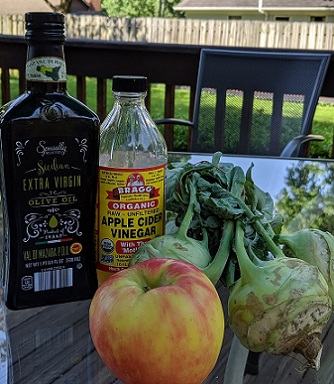
1 kohlrabi bulb, cut into matchsticks

1 apple cut into matchsticks

Olive oil

Apple Cider Vinegar

Salt and Pepper

Directions

Cut the kohlrabi and apple into matchsticks.

kohlrabi slaw

Mix the matchsticks in a bowl with some olive oil and apple cider vinegar. Use about a tablespoon of each, mix, and decide if you need any more.

Season with salt and pepper.

Refrigerate for at least an hour before serving.

kohlrabi slaw

Notes

I used honey crisp apples. The sweetness worked well with the vinegar and the kohlrabi. Certainly, try other apple types to see what works best for you.

I really liked this slaw. The apple provides a bit more sweetness than the kohlrabi and the kohlrabi provides a bit more crunch than the apple. The olive oil and apple cider vinegar add a bit of zing to the dish.

kohlrabi slaw

Fitness Challenge Recap

Recently, I participated in my gym’s fitness challenge. I was nervous about signing up because I felt like my training had been erratic this year due to injury and traveling but when I saw the list of activities, I decided to give it a try.

Fitness Challenge

We had one minute to complete the exercises with two minutes of rest in between. Here’s what we had to do:

  • Row on the rowing machine
  • Push ups, as many as possible. Women over 50 did modified push ups.fitness challenge
  • Dumbbell Farmer’s Carry. Women over 50 carried a pair of 30 pound dumbbells.Fitness Challenge
  • A running agility test. The goal was to do it as quickly as possible.
  • Dead lift four different bars with progressively heavier weights. Women over 50 lifted 75, 105, 135, and 155 pounds.

Fitness Challenge

  • Bike for two minutes.

Fitness Challenge

  • Inverted Rows. Women over 50 had to do 31 to get the maximum points.

Fitness Challenge

  • Ski ERG Go for distance.

Fitness Challenge

  • Treadmill Run for two minutes. The participant could set the treadmill at the speed he or she wanted and the distance was recorded.

Fitness Challenge

The total possible points was 36. I don’t think any participants earned a perfect score. Instead, the highest anyone earned was 34 points. I managed to get 29 points, surpassing my expectations.

I earned the highest possible points on everything except for the agility test, biking, the Ski machine, and the treadmill, proving that I’m strong but not fast. The exercises that required speed was my weak point.  However, I squeaked by on the rowing machine to get maximum points.

These fitness challenges are usually fun. The gym changes up what’s in the challenge so some are more enjoyable than others. I found this one to be both challenging and enjoyable.

My last challenge was a year ago. The format was completely different and was held outside. I won that one too. We really need to work on getting more women over 50 to compete. 


Health at Every Size with Erica Leon

What does it mean to have health at every size? Podcast #36 Becoming Elli Community

Download | Play in New Window
Please Subscribe: Apple Podcasts  (iTunes) | Google Podcasts | Android-Google Play | Stitcher | Player FM | Castbox | Tunein | Spotify | RSS

In episode 36 of the Fit Strong Women Over 50 Podcast, Chris Brown and Jill McCauslin talk with Erica Leon about body image, intuitive eating, and learning to live in a healthy way. Erica is a registered dietitian and is the owner of Erica Leon Nutrition, an outpatient group nutrition practice in White Plains, NY.

As a registered dietitian, Erica counseled people on diets, primarily to lose weight.  After 10 or 15 years of noticing that people kept losing weight, only to regain it and then return for yet another diet, she looked for another way to help people regain health.

Erica uses a “non-diet” Health at Every Size ® approach, which helps chronic dieters to discover their natural, internal signals of hunger, fullness and satisfaction.

Jill, Chris, and Erica discuss how Erica promotes healthy behaviors like physical activity, eating in a balanced way, and “regular” meals.  Erica says, “Intuitive eating allows you to focus on your bodily sensations.”

Healthy at Any Size

Some of the topics covered in this episode is

  • What harm the “diet culture” does to many women
  • Why a little more body fat for women over 50 is actually helpful for protecting the body.
  • Why the principle of habituation works

Some of Erica’s favorite mantras to eliminate negative voices are:

  • I am fine just as I am
  • I don’t need to please anybody
  • I am my own best friend
  • I believe in myself

Links

Intuitive Eating as a concept was developed by two revolutionary dietitians: Evelyn Trebley and Elyse Resch

Intuitive Eating: A Revolutionary Program That Works by Evelyn Tribole, M.S., R.D and Elyse Resch, M.S., R.D., F.A.D.A.

Intuitive Eating Workbook

Health at Every Size (The Surprising Truth about Your Weight) by Linda Bacon

Becoming Elli Mantras

Social Media

You can find Erica Leon at:

Facebook: Erica Leon Nutrition 

LinkedIn: Erica Leon Nutriton

Instagram:Erica Leon Nutrition

Twitter: Erica Leon RDN

Pinterest: Nutrafit1

The Fit Strong Women Over 50 podcast is part of the Becoming Elli community. Join us as we explore ways to be fit and strong.


Running After Injury: An Update on My Progress

Running after injury is a challenge. Since I’ve been working on getting back into running shape after having a year of aches and pains in my ankle and hip, I thought I’d give you an update.

I’ve finished week 8 on my Couch to 5K app, with only one more week to go. I’m no longer doing a walk/run training but instead am running for an extended period of time. For my most recent run, I ran for 28 minutes and other than slowing down to adjust my music, I managed to do it. The app takes me to running for 30 minutes so I guess we know where week 9 ends up.

It was a challenge, especially because I ran on a rather hilly course. Lots of huffing and puffing going up hill but I survived.

I’m improving my cardio vascular system, that’s for sure. I can tell that my recovery is pretty rapid. 

I notice some twinges with my Achilles tendon and with my piriformis muscle but nothing too severe. I’m trying to proceed slowly enough that I don’t have any significant pains. My goal is to acclimate my body to running again and avoid injury. After each run, I use my lacrosse ball and roller and try to get in my stretches.

I’m not sure how slowly I need to increase distance or speed but I think I’m going to aim for the ability to run two to three miles a few days a week. If I can do this for a few months, then I can think about running further.

Another 5K would be a great goal. Signing up for a race is a great way to motivate me for training.  I’m so much more motivated to train when I know that I’ve made a commitment to an event, especially when I’ve paid for it. Isn’t it amazing how putting money down for a race really makes one feel committed?

In order to prevent additional injury, I’m making sure to cross train so I’m not feeling to compelled to run more than three or four times a week. Twice a week, I try to do some weight lifting and then end each week with my boot camp class. I also try to incorporate yoga into my routine.  I talked more about this in our most recent podcast so be sure to check that out.

If you have some experience with coming back from an injury, please share it in the comments.

Improving Health with Training, Sleep, and Omega 3s

Download | Play in New Window
Please Subscribe: Apple Podcasts  (iTunes) | Google Podcasts | Android-Google Play | Stitcher | Player FM | Castbox | Tunein | Spotify | RSS

In episode 34 of the Fit, Strong Women Over 50 podcast for the Becoming Elli community, Jill and Chris discuss a variety of ways for improving health.

Improving Health

There’s more to becoming like Elli than we like to think. It’s not just eat vegetables and get 10,000 steps a day. Jill and Chris cover some of the other aspects of being fit and strong. They discuss:

  • their training this spring
  • problems that arise with sleep and how to avoid them
  • the importance of including Omega 3 fats in the diet
  • their progress on the Becoming Elli 2019 veggie challenge.

Training

Chris and Jill discuss how they’re training for progress into summer and how they’re dealing with or avoiding injuries. Biking, running, yoga, and strength training are the major forms of activities.

Chris is also giving back to the running community by volunteering at aid stations for a variety of races.

Sleep

Chris explains:

  • why sleep is so important
  • why it can be difficult to fall asleep
  • how to improve sleeping habits

She also discusses some new research about how our body “cleans” our brains while we sleep.

Links:

6 choices to change blue screen and reduce eye strain:

Dr Andrew Weil 4-7-8 breathing https://youtu.be/YRPh_GaiL8s

Omega 3 Fatty Acids

Jill discusses why it’s important to have Omega 3 fatty acids in your diet and ways to increase your consumption of Omega 3s. This includes using supplements such as fish oil or krill and foods that are rich in Omega 3s like salmon, sardines, and walnuts.

Links

Why we lack of Omega 3s

Foods with Omega 3s

Five Ways to Track Your Fitness Progress

Regardless of where you are in your fitness journey, it’s a good idea to track your fitness progress. It can make you feel proud of your accomplishments or make you realize that maybe taking that month off wasn’t such a hot idea.

You may feel like you just know where you are but I think most of us don’t realize how we’re actually doing. This is where it pays off to track your fitness progress.

Take Measurements.

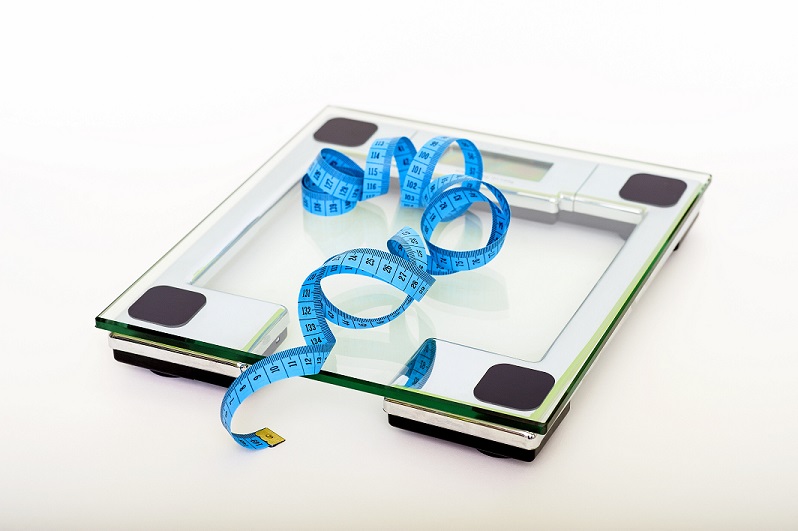
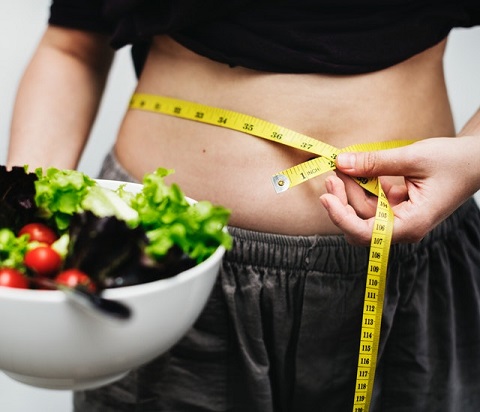
I’ve discussed the value of measurements before. I really like being able to see how I’m doing. I have a journal where I track my weight. I also include my measurements every few weeks. It’s a good idea to get a measuring tape and measure your waist, hips and maybe your thigh. Other parts of your body are difficult to measure on your own but if you have someone to help, you could throw in measuring your chest and your biceps.

track fitness progress

You certainly don’t need to measure every day but maybe once a month, look and see where you are. Even changing by half an inch may be a great sign of progress.

This might be where you track other measurements too. This can be numbers provided by your doctor from blood work or tracking your blood pressure or resting heart rate.

Take photos

Many of us hate to have our pictures taken, especially when we’re wearing our workout clothes. I urge you to get over that and take pictures of yourself. If you’re doing a selfie, you want to try to get most of your body in the shot so you may need to use a mirror for the shot.

Save your photos from races and group runs or group fitness events.

Again, photos can be motivating because you may see progress or you may see backsliding. You know that old saying, cameras never lie. Of course that saying is definitely old because now with PhotoShop and filters and everything, many photos do lie but try to keep the originals so you can track your progress.

Write Down Your Strength Workouts

I love weight lifting. If I could only choose one thing to do, I suspect that I would opt to just lift weights. One reason I like weight lifting is that it’s so easy to track your results. Why? Because you’re lifting WEIGHT and it’s easy to measure.

Today I did deadlifts in a fitness class and my max was 105 pounds. Now I know that last year I deadlifted 150 pounds so it’s easy for me to see that I either was slacking today or have lost some strength. I suspect that it’s a bit of both.

If you lift weights, keep track of your sets and what you’re actually lifting. Over time you can see how you’re gaining strength.

Record Weight and Body Fat

This is similar to taking measurements. Jump on a scale periodically. We’ve talked about weighing ourselves every day but many people dislike that. I suggest that you weigh yourself regularly and record it. It’s an easy way to see what your body is doing.

Perhaps more importantly is to track your body fat if you can. I get this checked at my gym every so often using a hand-held device.

Many scales are now available that also provide you with body fat numbers. I know many say that these scales aren’t accurate but I think they’re great for watching trends. As long as you’re using the same scale, you can see if that percentage is going up or down.

Test Yourself

Once a month or so, test yourself. See if you can lift more weight or do more reps in a set. You can do something like set a timer for a minute and see how many push ups you can do. Or you can do the opposite and do 20 burpees and track how much time it takes. If you do this regularly, you will probably begin to see improvements. You might get to the point where you think, “I hate doing 20 burpees” and then you’ll know it’s time to change the test.

Track Your Fitness Progress

It pays to track your progress. Whether it’s seeing that you’re an inch smaller at the waist or that you can do 3 more push ups than you did last month, it’s motivating to know that you’re improving.

Be sure to write this information down because, trust me, you won’t remember the details.

If you’re on this fitness journey long enough, you’ll eventually have photos going back years and that is invaluable.

Let me know if you do any of these things or if you’re going to add them to your routine. I’d love to hear how it works for you.

Ups and Downs of Fitness Past 50

Let’s talk about some of the ups and downs of fitness past 50. A few things happened this week that made me feel good and then not so good. There were definitely some ups and downs of fitness this week.

Ups and Downs of Fitness

First, I signed up for a small group training class at my gym. The seven-week class starts and ends with measurements so we can track our progress. The measurements included weight, body fat percentage (oh, it’s been a rough year!), blood pressure, and actual body measurements. You know, the measuring tape around your chest, abdomen, waist, hips, thighs, and upper arm. Not really a good time.

This was followed by a brief physical test. We did inclined push ups. Inclined means we rested our hands on an elevated surface and did a full push up. The test was to see how many we could do in a minute. The other test was four minutes on the rowing machine.

I did not feel great about the weight and body fat percentage. I definitely have some work to do there. Too much time dealing with injuries and too much time traveling and having fun last year. It’s certainly an incentive to pay attention to this.

I did feel pretty good that, although I am clearly the oldest person in the training group, I was not the worst at the push ups and rowing. There were a couple young women there who looked very fit and said they go to bootcamp classes three times a week, but they couldn’t do the push ups. They said they always do pushups on their knees in boot camp. I don’t want to sound petty but that made me feel better that I managed to do some.

Oh NO! A Photo!

The second thing I did this week was scary. I took a selfie of myself while I was out running. It was a sunny day and the selfie of course was a close-up. Oh my, what a shock when I looked at the photo. I did not upload it to Strava where I log my runs. Yikes, I looked so much older than I felt. I know it was a sunny day so I was squinting and it was not a flattering shot but boy it knocked me for a loop. Fortunately, I didn’t see the photo until after I finished my run.

ups and downs of fitness

I know it’s more important to have completed my run successfully than to look good in a photograph but I still have some vanity left and that was painful.

Recovery

OK, so this week has had its ups and downs. I’m carrying around more weight than I like and I know I’ll feel better if I get it off. I prefer to focus on the body fat percentage, but I definitely need to lower that number.

I looked like a zombie in my selfie. Note to self, avoid selfies in the bright sunlight while running. It’s not a good look. All future sellfies should be taken after recovery from running, preferably after a shower, combing the hair, and maybe even using some makeup.

On the plus side, I successfully completed some pushups and rowed for four minutes. I ran my Couch to 5K session without problem and felt good afterwards. I’m choosing to focus on that. You know, the “be fit and strong” thing.

I guess all we can do is continue to work on being fit and strong and try to improve where we can. Set those goals and don’t feel bad about what you can’t control.

If anyone has any ideas on improving the selfie look, let me know. More importantly, let me know if you’ve had some successes this week in your fitness regime.


« Older posts Newer posts »

© 2026

Theme by Anders Noren — Up ↑