Author: Jill McCauslin (Page 5 of 23)

Intermittent Fasting for Women Over 60

Intermittent fasting is one of the most popular trends right now in eating. People are using IF for both weight loss and health benefits.

Intermittent fasting is really an umbrella term for a variety of ways of fasting. Most often, people are really referring to Time Restricted Eating. This is where you avoid eating during a period of time. It can be as short as not eating after dinner and then having breakfast first thing in the morning. It can be longer than that, where you fast all day and then consume all your calories in a single hour. Most people who I hear talking about time restricted eating probably have a 16 to 18 hour window of non-eating, with a 6 to 4 hour window of eating.

Chris and I talked with Gin Stephens about Intermittent Fasting and she provided us with lots of information. If you are interested in learning more about it, I recommend  listening to our podcast episode, Intermittent Fasting with Gin Stephens.

Is time-restricted eating effective for post-menopausal women? There’s lots of discussion about IF for the general population but women over 50 tend to have unwanted weight gain so this might be a good option for them.

While I was reading some articles about IF, I came across a study published in the International Journal of Environmental Research and Public Health. It addresses weight loss for women over 60.

Intermittent Fasting for Women Over 60

The study enrolled 45 women over the age of 60. The women were randomly assigned to either the control group or to the group instructed to fast for 16 hours. The women assigned to the IF group were told to fast from 8 PM until noon the next day. Neither group was told to change what they ate, but only to change when they ate.

After six weeks, the women who fasted for 16 hours had a loss of about three pounds (1.4 kilos) and fat mass. The control group had no loss of weight. Compliance to the time-restricted eating was good with 88% of the women completing the study. No negative results were reported.

This study only lasted six weeks so the small amount of weight loss is not surprising. Also, it’s worth remembering that the study made no changes to the food the women ate.

This was a small study but appears to indicate that Intermittent Fasting (or Time Restricted Eating) can be a good tool for women trying to lose weight.

I also think it’s great to see studies being done of older women. It’s unusual for studies to be of women over 50, or 60 in this case. It’s unusual to see a study on Intermittent Fasting for women over 60.

Running and Grief

Is there a connection between running and grief? I think perhaps there is. Not for everyone, of course, but for some of us dealing with grief, running provides some mental health benefits.

There’s a lot of discussion about how running helps with our mental health. If you want to read a great memoir about this, check out Depression Hates a Moving Target by Nita Sweeney. Chris and I talked with Nita about running and mental health on our podcast. You might check that episode out too.

I don’t know if there’s much specific talk about running and grief, which is different than depression. Grief causes a lot of different emotions; sadness, anger, guilt, loneliness are a few. I think what makes running helpful is that it provides an outlet for all of that emotion stored up inside.

When my husband died, I felt bereft. I was angry that other women still had their husbands. I was lonely and worried about my teen-aged son and I felt completely unprepared for life on my own. Grief is an overwhelming emotion.

Shortly after my husband’s death, I began to go to the gym. I was overweight and out of shape because I’d been taking care of him for a couple of years and just couldn’t focus on myself. Once I started going to the gym, I used the weight machines and the cardio equipment, basically both the treadmill and the elliptical.

At some point, I decided that running would be helpful.

I don’t think I was thinking too much about getting in shape but I felt horrible and needed to do something. I downloaded a Couch to 5K app and began to try to run. I’d never been a runner before in my life, so this was a novel activity for me. Looking back, I can’t quite say why I decided to take up running. It just seemed like a good idea.

The act of running makes you think about something other than your day-to-day details. My mind would wander, and I’d be completely away from my sadness. You really have to focus on your body and what’s around you and less on what you’re feeling.

Also, getting better at something helped my mental state. I would do a particular week of my Couch to 5K and if I couldn’t move on to the next week, I’d repeat the current week. Eventually, I’d be able to move on. When I ran 30 minutes without stopping, I felt so happy with myself. That moment of success was fantastic.

Just the act of going outside to run helped. I put on running clothes of some sort and my running shoes and prepared to go out. Just having to do the prep work helped me feel better. I put together a play list and figured out how to have water handy. Those details were something different to think about.

I went to a grief support group for a while. A couple of women said that when their husbands died, they spent months in bed and never went out. That’s when I realized that we all grieve differently. I couldn’t

Losing a loved one is so hard. I’m not saying that running makes it better, but it makes facing life and grief just a bit easier.  There’s some time where you’re not focused on your grief but instead on how it feels to run.

Do you think running has helped you with grief? Or some other kind of fitness? I’d love to hear from you.

Ways to Get Started with Strength Training

One thing I’ve noticed in the Becoming Elli community is that many of us are looking for ways to get started with strength training. Many women who have joined the Becoming Elli Facebook group (it’s a private group and if you haven’t joined, please do so!) want to get started with strength training.

Most of us know how to do cardio exercises. We use the treadmill or the elliptical or we bicycle indoors and out.

If you listen to the Fit Strong Women over 50 Podcast, you know that we talk a lot about the importance of strength training for women as we age.

Why Strength Train?

We lose muscle more quickly than men and that loss begins earlier than we’d like to think about. Losing muscle makes it harder to keep our metabolism going at a good pace. It makes it harder to move. There are lots of reasons why we should be strength training, also called resistance training. We can go into those reasons in a different post.

There are lots of ways to do strength training, whether you belong to the gym or workout at home but we can all use some help in getting started. You can use weights such as dumb bells, kettle bells, and resistance bands. You can also use your own body weight doing things like squats, push ups, and lunges. Knowing what you can do is, of course, not the same as actually doing it.

Ways to Get Started with Strength Training

I’ve come up with a few ways to help get started with strength training.

Set Goals

Set goals with a timeline related to strength training. While long term goals are great, be sure to include some shorter term goals as well.

Perhaps your long term goal is to be able to do ten regular pushups. That’s a great goal but it may take you a while to get there so make some goals to hit on the way. Perhaps it’s to be able to do ten modified pushups. Then you can make a goal of being able to do one regular pushup. Finally, you hit that long term goal of ten regular pushups.

Invest in Yourself

I find spending money on something is a big motivator. If I pay for a training class, I’m much more likely to go. Perhaps you buy some new weight equipment to include in your home gym. Buying a kettlebell is sure a major investment. Or perhaps you pay to access a strength training app. Or you pay for personal training. Whatever it is, I think most of us do more when we’ve made a financial commitment to something.

Sure, people buy treadmills and gym memberships that they don’t use but I think if you combine the desire to get started with strength training with the financial commitment, you’re more likely to work at it.

Tell people what you’re doing

Tell friends and family member. Confide in your co-workers. If you’re open about wanting to get stronger, you’re more likely to get some support. It helps to tell people who also strength train or workout in some way. I remember telling my mother what I was doing and she really only walked. She told me I didn’t need to be doing this, that walking was enough. So telling your friend at your yoga class might be better.

Find support

Do you have friends who are also interested in strength training? If so, try to work out together. If that’s not possible, maybe try comparing workouts and giving each other ideas of things to try. Online communities, such as the private Facebook group for Becoming Elli, can be helpful. If you’re feeling overwhelmed, discussing with like-minded people can help.

If you’ve joined a gym, talk to the staff. There are people there who can show you how to do different exercises or how to use a piece of equipment. Take advantage of that resource.

Try to Improve

Look for ways to improve. I guess this might be related to goals but what I mean is, just be aware of your body and what you’re capable of doing. If last week, you could only carry two plastic bags of groceries, see if you can increase to three this week. If you can do biceps curls with 8 pound dumbbells, see if you can bump it up to 10 pounds.

Give It a Chance

Stay out of your head. Some of us start strength training say we don’t like it. The problem with that is we usually don’t want to do things that we dislike. If you work on having an open mind, you may realize after awhile that you’re actually enjoying yourself. Give it a fair trial. I really work on no longer saying, “I hate this” when doing squats.

Suggestions?

We know that strength training is important for us as we age so it’s important to figure out ways to get going with it.

What suggestions do you have? I would love to hear other ideas. Comment below if you have something to share.

My Roasting Eggplant in the Air Fryer Experiment

If you Google how to roast eggplant in the air fryer, you will discover a lot of recipes. Trust me on that. I found lots of different recipes for roasting eggplant, even when I limited my search to using the Air Fryer.

I asked in the Becoming Elli Facebook Group (join us there if you haven’t already!) if anyone had any good ideas on what to do with eggplant. People made many suggestions so I have ways to prepare eggplant for a while. I also checked for other eggplant recipes in this site and found one recipe that Chris posted. It sounds good too so I may add that to my list of ways to prepare eggplant.

Roasted eggplant was one of the more popular suggestions so I decided to give that  a try. I love most roasted vegetables so I thought roasted eggplant would probably also be good.

Once I started researching the best way to roast eggplant, I found the one dividing point between cooks.  Salting the vegetable before cooking or not.

Eggplant has a lot of moisture in it. Typically if you’re making eggplant parmesan or some other Italian eggplant treat, you’re instructed to salt the slices of eggplant to draw out the moisture.

Some of the recipes for roasting eggplant insist the only way to get crips eggplant is to salt it first and remove the moisture. Other recipes said it doesn’t matter and you can skip that step.

The other discrepancy between the roasting methods was about removing the skin first. Some recipes said to peel the eggplant before cooking and other recipes said to keep it on.

To Salt or Not to Salt

I decided to try both methods of roasting. I cut one eggplant into cubes and cooked half at a time.

To make sure I was conducting a fair experiment, I kept everything the same with both batches. I used the same oil and the same spices for both batches. However, I sprinkled salt on one batch and let it sit for about 30 minutes. The second batch I roasted without bothering with the salt.

I decided to leave the skin on the eggplant because my inclination with all vegetables is to leave the skin on if possible. For one thing, it’s a lot easier not to peel a vegetable before cooking. Secondly, it seems that for most vegetables, there’s more vitamins and fiber if you keep the skin on the vegetable.

Easier and better for you? Let’s try keeping the skin on the eggplant.

Roasting the Batches

For each batch of eggplant, I used about a tablespoon of avocado oil and then sprinkled on a mixture of spices. I used pepper, garlic powder, oregano, and a pinch of red pepper. Because I knew one batch would already be salted, I did not add salt to the spice mixture.

I roasted the first batch (the unsalted one) in the air fryer at 400 for about 15 minutes. I shook them up a couple of times while cooking. When they came out, the pieces were very dark so I thought I had burnt them. It turned out that they were fine but just had a dark color.

The second batch sat in a colander with the salt on for about thirty minutes. I stirred them occasionally to help remove any moisture. When I was ready to roast them, I wiped the salt and moisture off the eggplant chunks, and then prepared in the same way as the first batch.

I did cook the second batch for a couple of minutes less than the first batch. I thought I had burnt the first batch so wanted to try for a slightly shorter time.

Results

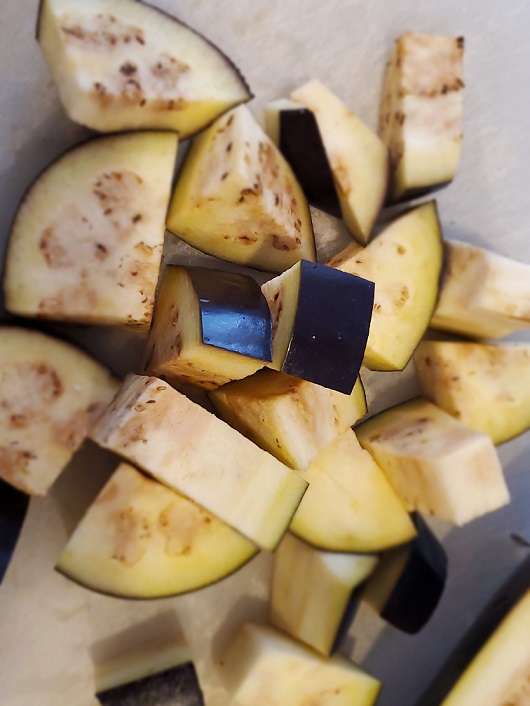
By the time the second batch had finished cooking, I had eaten most of the first batch. I forced myself to leave some so that I’d have them when the second batch finished. You can see in this photo how much I ate in the 12 minutes the second batch cooked. (The second batch is on the left. I know, they should have been on the right.)

The second batch was also good but did have a saltier flavor than the first batch. I was glad that I had not put any salt in the spice mixture.

I did not notice any difference in the crunchiness of the eggplant. Based on this small experiment, I would say you can safely skip the salting and wiping off part of the process.

And what about the skin?

The roasted eggplant became very soft so the only real crunch was from the skin. I really liked it. I thought the roasted skin added some great texture to the dish.

The result was that I ate an entire eggplant as a snack in the middle of the afternoon. It was delicious.

Roasting Eggplant in the Air Fryer

So here’s the simple recipe I used for the eggplant.

Ingredients

Eggplant

Oil

Spice Mixture. Use what you want for this but I used about 1 teaspoon each of oregano and garlic powder, ½ teaspoon of black pepper, and a scant 1/8 teaspoon of cayenne pepper.

Cut the eggplant into about one-inch cubes.

Toss them in about a tablespoon of oil. I used avocado oil but olive oil would work well.

Mix the spices together and then toss with the eggplant cubes.

Add the eggplant to the air fryer.

Roast at 400 for about 12 minutes. Stir at least once, halfway through the cooking.

These were good hot, right out of the air fryer, warm, and at room temperature.

They weren’t around long enough for me to try them on salad or any other dish.

I’m still open to other ideas for eggplant but I absolutely loved the roasted eggplant.

If you have any suggestions about roasting eggplant in the Air Fryer, other ways to cook eggplant or roasting other type of vegetables for me, be sure to share them with me.

Rediscovering the Treadmill

What’s this about rediscovering the treadmill? My treadmill certainly hasn’t gone anywhere. It’s right there in my cardio room. That’s what I now call my home gym area. My bike on a trainer and the treadmill are in one room with all my fitness toys. You know, yoga mats, dumb bells, resistance bands.

I recently decided to get back into more of a regimented fitness schedule and try to have something scheduled for every day of the week, even if it’s rest day. Currently, I am going to the gym to meet with a trainer twice a week. I’m going to have to write a separate post about that experience! Those two days are accounted for. Then I added one bike day. Since I started this in January, my bike day is on my indoor bike. Now I added two days of running on the treadmill. It can be a day of intervals or just a steady easy run. I include one day of yoga or some kind of flexibility training and then one day for rest or an easy hike or some other kind of active recovery. That accounts for the whole week.

Today I did a run/walk interval thing with increasing lengths of run time and decreasing lengths of walk time. It felt great. When I first returned to the treadmill, I had a hard time running. So I did a brisk walk on it. I’ve worked myself back to running on it though I’ve noticed that I’m definitely slower than I used to be.

I’ve been avoiding my treadmill yet again so I’m glad to return to it. It’s so easy to skip cardio activities when you’re stuck indoors for days at a time, even though I know I need it.

Searching for my past posts about treadmills on the Becoming Elli site, I discovered a post I wrote a couple of years ago, Renaming the Dreadmill or How to Change Your Attitude. I saw the title and actually thought that Chris wrote it but no, I wrote it! What I wrote it in 2020 inspired me today in 2022. (I don’t know why but I really like that I’d forgotten about this post and when I read it, I felt motivated.)

Because I have my activities scheduled for each day, and I’ve told my boyfriend what those things are, I’m much more likely to complete them. So far, I’ve managed even if I had to switch days around a couple of times. Mainly, I had to move my rest day because something happened that prevented me from doing what I had scheduled. Definitely the schedule is working. At least my commitment to the schedule is working.

I log everything into Strava via Garmin or Zwift. I like seeing the activities adding up in my account. So far I’m enjoying rediscovering the treadmill.

I’ll keep you posted on how this scheduling works over the next few months. What are you doing to keep yourself active? I’d love to hear.

Making Beef Bone Broth

I made beef bone broth yesterday using the bones left over from the roast I served on Christmas Day. The roast was from a local butcher with pastured raised beef, so it was delicious though expensive. I had several bones left over and hated to just throw them away, so I decided to make some bone broth.

The last time I made beef bone broth was several years ago. I used my slow cooker to make it. The problem with the slow cooker was that it was indeed slow. I had to let it cook for over twelve hours to get the most nutrients out of the bones.

This time I decided to make the beef bone broth using my Instant Pot. I did a little online research for recipes for beef bone broth using the Instant Pot and realized that I could speed up the process a bit.

Making Beef Bone Broth

Here’s how I made my beef bone broth. Because I had roasted the meet the day before, the bones were already roasted. Therefore, I could skip the step that many recipes suggested, roasting the bones before making the broth.

I put the bones in the bottom of the Instant Pot and then added some roughly cut onions, carrots, and celery. I also threw in a couple cloves of garlic and a couple bay leaves.

Finally, I added a couple tablespoons of apple cider vinegar. The vinegar is supposed to help release the minerals from the bones.

Then, I filled the pot with water, up to the Max Fill Line. My Instant Pot has a soup button that lets me set the Instant Pot for four hours so that’s what I used.

Because the Instant Pot was full with lots of liquid, it took a long time to come to full pressure. Once it started to cook and some time went by, I bumped the time back to four hours again. Therefore, I cooked the beef bone broth for probably about 5 and a half hours. I also let the Instant  Pot release naturally. Again, because the pot was so full, it took a long time for the pressure to release fully.

Once the pressure was released, I remove the lid and saw a pot full of beautiful broth and all of the cooked vegetables and bones. I removed the bones and vegetables with a spoon and then poured the broth through a fine strainer into a large Pyrex measuring bowl. Then I decanted the broth into some Mason jars. I placed the jars into the refrigerator and once the broth had cooled, I removed the fat that congealed on top.

If you want to see some controversy, just ask about removing the fat from the broth. People who are following a Ketogenic diet often keep the fat in the broth. I felt like there would be sufficient fat in it even with me removing the fat on top.

I drank a cup of the beef bone broth that afternoon. First, I heated some in the microwave and then sprinkled some Himalayan pink salt on top and drank it. Wow! It was good.

Recipe for Beef Bone Broth Using the Instant Pot

I guess I should write this up as a recipe for you. Here you go:

Ingredients

Approximately two pounds of beef bones of any kind, or how much you have

Roughly cut onion, carrots, and celery or whatever you have on hand.

1 or 2 cloves of garlic

Bay Leaves

1 tsp Salt

1 tsp Pepper

Enough water to cover the bones and vegetables.

2 Tablespoons Apple Cider Vinegar

Directions

Place the roasted bones in the bottom of the Instant Pot.

Add the vegetables, garlic, and bay leaves.

Pour in enough water to cover the bones and vegetables. Do not exceed the Max Fill Line.

Add salt and pepper and the Apple Cider Vinegar.

Stir together.

Add the lid and set the Instant Pot to high pressure for five or six hours, if you can. Mine only goes to four hours so I set it to four and then added another hour once it started to cook.

Let the pressure release naturally.

Strain the broth and pour into jars.

Refrigerate the broth and remove the fat that has risen to the top.

Use the broth in soups or sauces or just drink it straight. I added salt to mine for drinking.

Ten Tips for Staying Fit and Strong Over the Holidays

This year many of us are having a more festive time than we did last year during the pandemic shutdown. After all of our work throughout the year to be fit and strong, we sure don’t want to undo everything. However, we still want to enjoy the festivities that come our way. In 2019, I wrote about enjoying the holidays but today I want to focus on actually trying to stay fit and strong.

Ten Tips for Staying Fit and Strong Over the Holidays

Not to worry. I have some ideas that might help you not lose ground or gain weight but that will still allow you to celebrate the season.

  1. Keep moving. Remember all of those tips about how to get in extra steps? This is the time to use them. Yes, take the stairs instead of the elevator. Park further away from the door at the store. Carry multiple grocery bags in from the car or take multiple trips, depending on whether you want some strength work or more steps. Exercise sometimes falls away during the holidays but at least keep your body moving.
    Ten Tips for Staying Fit and Strong Over the Holidays
  2. Drink lots of water. Stay hydrated. It’s easy to get out of the routine of drinking water while we’re enjoying the holidays but water helps us in so many ways. If nothing else, it helps you feel full and it helps flush your body of all the not-so-good-for-you things you’ve ingested.
    Drink Water
  3. Plan your meals. I mean, make sure you’re eating before it’s time to go to a party. Make sure you’re not starving when you go to the grocery store. Don’t forget to eat according to your schedule.
  4. If you are using an intermittent fasting plan, don’t break your fast with alcohol or junk food. You’ll feel terrible. Trust me on this one.
  5. Pay attention to alcohol. If you drink too much, you’ll lose restraint and eat things you didn’t plan to eat. You’ll wake up feeling lousy. Of course you can enjoy some drinks during the holidays but don’t overdo it. This might a good time to include some sparkling water into your routine. It helps you with drinking water (see tip 2!) and helps you avoid over doing it with the alcohol.
    Ten Tips for Staying Fit and Strong Over the Holidays
  6. Schedule a workout. Go to your regular yoga class or strength class at the gym. Jump on your Peloton bike (or other indoor bike!) and go for a ride. Do something to keep your body active. This might be the time to forget those lengthy workouts and go for a quick HIIT session.
  7. Plan in advance for food you want to eat. If you’re going to a party or someone else’s house, take something that you know you’ll want to eat. Maybe this could be a veggie tray or cut up fruit. Shrimp Cocktail is a great source of protein and is a standard holiday treat. Of course, take plenty so you can share.
  8. Make sure you’re getting your sleep. Try to keep to your normal schedule as much as you can and practice good sleep hygiene if possible. You know, turn off the screens earlier in the evening, have a cool, dark space for sleeping, and anything else you do to sleep well. Remember that alcohol can really mess up your sleep so that’s another good reason to limit your alcohol intake (Tip 5).
  9. Plan on indulging. I know that I have a couple of days during the holidays when I’ll be joining family and friends for celebrations. I’m not going to refuse to eat delicious things and have a good time. This might be a good time to consider portion size, though. If I’m going to eat that decadent cake, I will enjoy it but perhaps I only need a small slice. Maybe not but I should at least consider it. Either way, I can go for a fantastic dinner one night and the next day get back on track with my standard meals.
    Ten Tips for Staying Fit and Strong Over the Holidays
  10. Focus on yourself for at least a few minutes every day. Perhaps you meditate or do some deep breathing exercises. Just be still and find your inner self. Celebrating and spending time with family can be stressful even when it’s enjoyable. And many of us have more stress during the holidays than we do enjoyment. Either way, taking a few minutes to relax, reflect, and recharge can only help.
    Meditate

What do you do to stay fit and strong over the holidays? I’d love to hear some of your tips.

Ten Ways to Develop Sustainable Fitness

How do we develop sustainable fitness? Last week I wrote about what sustainable fitness is. Basically, it’s doing things that you can continue to do long term. It’s focusing on ways to continue to be fit once a short term goal is met.

Sustainable fitness is figuring out how to be able to continue to move through our daily lives and be able to accomplish what we want to accomplish.

Chris and I have talked about wanting to be able to lift our own suitcases. That’s what sustainable fitness does for us.

So here are ten ways to develop sustainable fitness.

  1. Accept that there will be ups and downs in your journey. We will deal with illness, either our own or someone in the family. We may experience injuries. The point is that we have to be willing to deal with those bumps in the road and not let them deter us.
  2. Be consistent. It’s hard on us to work out hard and then quit for a while and then come back to it. It’s better to focus on consistency. Do something every day even if that something is the decision to take a rest day. If you know you work out in some form six days a week, then it’s fine to rest for a day. Just be consistent with what you do.
  3. Find things you enjoy. If you love playing pickle ball, then play pickle ball. If you hate going to the gym, then don’t go to the gym. It’s a lot easier to work on things when you enjoy what you’re doing.
  4. Accept that you’re not going to love every moment. The flip side of finding things you enjoy is that sometimes we know we need to do something even when it’s not our favorite thing. So if you are committed to doing some form of High Intensity Interval Training (HIIT), and you don’t really love it, you are still doing to figure out a way to do it.
  5. Remember that you’re in this for the duration. You’re not just trying to accomplish a goal by next month and then be done. You’re going to continue on your fitness journey, even after those short term goals are met.
  6. Find things to celebrate. You can now deadlift a higher weight? Celebrate! You ran a longer distance? Be proud of yourself! It’s not just the big things that we should celebrate. It’s all of the progress we make over time. Be thankful that you can do what you do.
  7. Be realistic. If you haven’t been to the gym in a year, don’t expect yourself to be doing what you did then. When I returned to bootcamp recently, I realized that I was really deficient in some of the cardio exercises we were doing. I can’t expect myself to do what I was doing two years ago without giving myself time to improve.
  8. Look for ways to train every day. You don’t have to go to the gym every day but you do have to live your life every day. So maybe that’s carrying in your groceries or carrying laundry. It could be walking up the stairs instead of taking the elevator.
  9. Enjoy being able to do things. If you’re carrying your groceries, be proud that you can do that. If you suddenly can run up a hill, enjoy doing it. Look for the ways that working on your fitness allows you to improve your living. Maybe it’s being able to get on the floor to play with a grandchild. Just relish your mobility.
  10. Find support. If you’re going to the gym, seek out others to discuss your progress. Find friends who share your fitness enthusiasm. You can get support from online communities, like the Becoming Elli Facebook group. Just surround yourself with people who will cheer for you on your way to develop sustainable fitness.


Share your ideas on how we can focus on the long term and enjoy doing it.

What is Sustainable Fitness?

I read a book a few years ago by a woman who was over 50 and lost a lot of weight. It was both her personal story and some advice on how to lose weight and develop some fitness. I didn’t remember a lot of the details but when I went back to the book recently, I realized that she said she lost 60 pounds in four months. Who knows if she actually did or not, though that seems extreme but I know it took me a long time to lose 60 pounds.

I had thought of her because I thought perhaps she’d be a good guest on the Fit Strong Women over 50 podcast. (You do listen to that, don’t you?!) We like to talk with women who have made a change in their lives and then manage to keep the weight off or to remain fit and strong. I can’t find her. The author of the book does not seem to be around.  I Googled her, searched on Amazon, looked on Facebook, and just can’t find her. No big deal as far as the podcast goes but I don’t know if she is still at her ideal weight and is still working out or not. I’m now sort of curious.

Quick Fix Fitness

This got me to thinking. It’s hard to stick to a way of eating or of working out when your initial goal was to look good for a wedding or a reunion or any other one time event. Yes, you might reach your goal but after that event, what happens? Most of us slide right back into our old ways and we gain that weight back and lose that muscle we’d built.

I knew a man who lost over 100 pounds so that he could go on a rugged camping trip with his son. You had to be under a certain weight based on height to be allowed to participate in the event. He did it and he went on the trip. Immediately upon his return began to eat ice cream and candy again. You know what happened. He soon weighed more than when he started on that weight loss journey.

I think it’s more important to focus on long-term fitness or what I’ve seen called sustainable fitness.

What is sustainable fitness?

I’ve now read several articles about sustainable fitness. Basically, sustainable fitness is a long-term plan. It’s doing things that you can continue to do regularly and frequently.

It’s setting goals that get you through the long term.

For example, when Chris and I ran our second relay race in the Akron Marathon, we had a couple of team members drop out at the last minute. We scrambled around and found a couple of women who were willing to be on our team and were able to run the five or six miles.

I said to Chris, “that’s what I want to be able to do. I want to be the kind of runner that can run five  or six miles without notice.”

So the goal of running the relay race was a short term goal and there’s nothing wrong with those. Unless, of course, you just stop once you reach that goal. Many of us do that. We run a marathon or half marathon or whatever distance we’ve selected and then once we accomplish it, we stop running.

The goal of being able to run five or six miles at any time is part of sustainable fitness.

My ability to run five or six miles has fluctuated since then but I’ve managed to be able to run something. Right now, I could certainly fill in on a relay team as long as nobody wanted me to be fast.

Conclusion

It doesn’t matter whether you’re talking about fitness or food. The best way to approach either or both is to focus on what is sustainable. What can you do on a regular basis?

Let me know how you maintain your fitness or weight or general health.

What I’m Thankful For This Year

Today in the US, it’s Thanksgiving so I’m going to share what I’m thankful for this year. Those of you not in the US, I’m sure it gets tiresome listening to us go on about being thankful every late November because really, shouldn’t we be thankful a little more frequently? Well, yes, we should. However, I don’t think it hurts to actually stop and think about it. As we head into the end of the year and facing the beginning of a new year, it doesn’t hurt to contemplate what we can be thankful for.

I know that many of us have had some very rough times the past almost two years now. I’m certainly not ignoring that but I think I can come up with some things to be grateful for.

So here goes my list.

Family

First of all, I’m so happy that my son and his wife now live close by. It’s a pleasure to be able to see them more often than when I had to drive seven hours to visit.

Also related to family is that I didn’t have to make any emergency trips to help someone out this year. I’m sad about that in a way because both of my parents passed away last year.  They were the ones who usually needed help. I certainly miss them. It was good, however, not to have to make those frantic, last-minute trips.

I went on several camping trips this past summer and had some wonderful times. My trip to West Virginia was fantastic. That’s where I experienced a Zip Line for the first time.

Becoming Elli

I’m grateful that the Becoming Elli community is growing. Our podcast, Fit Strong Women over 50 is going well and I love the people we interviewed this past year. We have some momentum going, I think, so I expect next year to be even better.

Fitness

I’m thankful that I was able to run a half marathon this year. I accomplished that goal by trying a new style of running. This time I used a run-walk routine. I was not fast but I finished the race and was not injured.

I also managed to continue with my strength training this year. Perhaps not as strenuously as I would have liked but I kept at it.

My gym also managed to remain open for which I’m very grateful.

I’m also thankful that I was able to return to  my bootcamp class without too much difficulty. I certainly identified some areas that I need to work on but I was pleased that I made it through my class.

I’ve also been able to do some of my indoor bike rides using Zwift. I’m certainly thankful that I’m able to make it through my rides even if, once again, I’m not very fast.

Penny

Penny continues to be a great companion for me. She is learning to run with me but it’s still a challenge. She’s easily distracted by squirrels and fascinating smells. She is a lot of fun to have around. She is such a happy soul that even if she never really runs with me for any distance, I enjoy having her.

What I'm Thankful For This Year

Feel free to share what you’re thankful for this year. Have a happy Thanksgiving.

« Older posts Newer posts »

© 2026

Theme by Anders Noren — Up ↑