Category: Food and Drink (Page 3 of 10)

Fit, Fierce, & Fabulous with Karín Feltman

#134 Fit, Fierce, & Fabulous with Karín Feltman

Download | Play in New Window
Please Subscribe: Apple Podcasts  (iTunes) | Google Podcasts | Pandora | Stitcher | Player FM | Castbox | Tunein | Spotify | RSS | Amazon Podcasts | iHeartRadio |

In episode 134, Jill and Chris talk with Karín Feltman, a registered nurse and the author of Fit, Fierce, and Fabulous Over 50! Her first book was Plant-based Basics. Her work focuses on holistic health for women over 50, with a particular focus on intermittent fasting and healing through nutrition.

She is a full-time cross-cultural worker in Nepal. She doesn’t always have access to the Internet so we’ve been waiting for a chance to talk with her. She graciously made time for us when she was available, technology-wise.

Karín was a hospital nurse for 23 years, before beginning work in relief provision and mission trips. She now works on empowerment projects for vulnerable girls and women in Nepal and uses her writing to help fund greater opportunities for the communities she works with.

She completed the VegHealth Nutrition Mastery Course with the VegHealth Institute, and continues her research on holistic health and healing.

Karín is a self-confessed foodie and loves discovering delicious new plant-based recipes, picking up fresh ideas from every new culture she visits.

Karin Feltman - 134 Fit Fierce and Fabulous Over 50

We discussed:

  • Her work in Nepal and why she chose that lifestyle
  • Tools needed to start intermittent fasting
  • Dealing with a chronic health condition
  • Why she wrote her book for women over 50 who want to prioritize their health
  • Getting enough protein on a plant based diet
  • Benefits of a plant based diet
  • Favorite recipes of hers that a quick, easy and healthy
  • What is anti-inflammatory intermittent fasting

Links:
Fit, Fierce, and Fabulous Over 50 on Amazon

Plant-Based Basics: An Easy to Follow, Step by Step Guide to Transitioning to a Plant Strong Diet and Lifestyle on Amazon

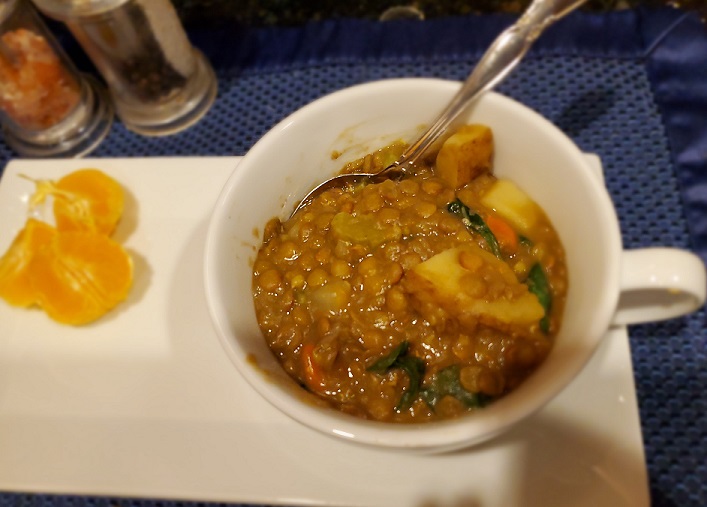
Instant Pot Lentil Soup with Potatoes and Spinach

I thought I’d share my recipe for lentil soup with potatoes and spinach made in the instant pot.

Chris shared with you a picture of her soup that she had when we went out for lunch. She always gets the v9 soup. I always get their lentil soup. I rarely make lentil soup but I really enjoy it.

So since it’s a cold wintry day today and I had the lentils in my pantry, I thought I need to make some soup.

This recipe is fast to make and is easy.

Ingredients

1 Tbsp olive oil
One onion diced
Two cloves garlic minced
1 carrot, diced
1 celery stalk diced
2 White potatoes, diced
1 16-oz package of green lentils
One bay leaf
Four cups of chicken stock
Two cups of water
2 to 3 large handfuls of fresh spinach
Salt and pepper to taste
1/8 tsp red pepper ( optional )
1/2 Tbsp apple cider vinegar

Directions

Turn on the saute function on the instant Pot.
Add olive oil and heat.
Saute the diced onions for about 5 minutes, until translucent and tender
Add minced garlic and saute for another 30 seconds.
Stir in celery and carrots. Saute for a few more minutes.
Add potatoes lentils, bay leaf, broth and water.
Stir.
Put the lid on the instant pot.
Using the manual option pressure cook on high for 7 minutes
Let the pressure release naturally.
Once the pressure has released, remove the lid, and stir in the spinach. Stir until the spinach has wilted.
Add the salt and pepper to taste. Add the cayenne pepper if you want.
Stir in apple cider vinegar.

Notes

Because there’s a lot of liquid in this, it will take the Instant Pot a while to build up pressure and then to release pressure.

If you want to make this vegan, substitute vegetable broth for the chicken broth. I just used what I had on hand.

This recipe is easy to adjust. Increase or decrease the vegetables as you want.

Potatoes can be whatever you have. I used white because they were in my pantry. Golden potatoes or red potatoes would be great too. Sweet potatoes might be an interesting variation.

I did not add much spice to this but you certainly could. This is a pretty mild soup so some herbs or spices might work well in it. I think some cumin and chili powder would work. Some curry powder would probably be tasty too.

Let me know if you try making this recipe and what you think.

Drinking More Water

I decided that I should be drinking more water and so I started logging my water consumption on my Fitbit app.

Last summer, I posted about hydration guidelines so I went back and reread what I wrote. I really should listen to myself more because I had good advice there.

When I first started, I realized that I wasn’t drinking nearly as much water as I thought. Drinking more water was going to take some planning.

One thing I realized is that I dislike drinking water in the morning. I don’t know why but I’ve always felt that way. If I don’t start early in the day, though, I end up either being short on my goals or of drinking a lot of water right before bed. You know what that leads to…trips to the bathroom during the night.

In fact, just sitting here writing this made me realize that I’m way behind on my water consumption today. If I don’t get some water quickly, I’m going to be chugging lots of water this evening.

You can find all kinds of recommendations for how much water to drink but I decided to just go with the standard recommendation of 8 servings of 8 ounces of water. In other words, 64 ounces or one half gallon each day.

Logging my water consumption makes it easier for me to see what I’m doing. I’m using my Fitbit app for tracking. I like seeing how many ounces I still need to get and how many days in a row I’ve met my goal. As you can see, I don’t make it every day but I’m doing better than when I first started to track.

I guess there’s not much these days that can’t be quantified.

Drinking water is supposed to be good for you though I haven’t noticed any real changes yet. I’ve only been working at this for a couple of weeks so perhaps the improvements are not really visible yet. I do notice that drinking water reduces my hunger during the day.

How about you? Are you tracking anything new? Do you drink lots of water? Maybe more than 64 ounces? Let me know in the comments.

Making Winter Meals Colorful

The weather has been very overcast and damp the last few weeks here in Ohio, so I have made a point to try to focus on making colorful winter meals with my soup and salads. Some people call it eating the rainbow.

It’s almost like a mini hibernation feeling for me during January and I find that if I focus on having hearty soups and colorful salads,it helps to keep me eating healthy with a focus on lots of vegetables and getting protein. I also added in a seafood photo for an extra happy oomph.

Here are a few of my favorite meals that I will share with you for inspiration:

Making winter meals colorful - soup

Homemade chili – this is a chili with ground beef, cabbage, pork and black beans, made in the crock pot with plenty of left overs for the freezer.

Making winter meals colorful - salad

Chopped carrots, red, yellow and orange peppers, crinkle cut cucumbers, celery, diced onion, tossed with a can of garbanzo beans (aka chick peas) over a bed of spinach.

I usually make enough of this salad to have as a main meal (with tuna) and then several side salads over a bed of spinach or spring mix greens the following day. This is similar to my potluck salads. My dressing is usually lemon juice, cider vinegar, olive oil, basil, oregano, pepper. It can be a lot of roughage if you’re not used to eating lots of veggies.

Making winter meals colorful - salad

Cyprus salad with marinated olives, cucumber, caprese tomatoes, crushed feta cheese, crispy chickpeas and roasted chicken over a bed of romaine lettuce. Rosemary vinaigrette dressing on the side.

There is nothing like little tomatoes cut in half for making winter meals colorful!

Making winter meals colorful - soup

V-9 soup from a restaurant named Aladdin’s. Jill and I had lunch together and I almost always get this soup because of all the veggies. This delicious soup is homemade with carrots, celery, tomatoes, zucchini, yellow squash, potatoes, green peppers, onions, and sweet peas. The sprinkling of feta cheese was optional – you can see it floated to the front of the dish.

I recently got out of Ohio for a few days and flew down to meet up with some friends in Florida. They treated me to this awesome fresh seafood extravaganza. While I wanted to share all the photos of my vacation food with you, it seems too indulgent, so here is just one of the stone crab with mustard sauce on a bed of ice.

Making winter meals colorful - seafood

Zero fat or carbs, but 3 ounces provide 15 grams of protein and 45 mg cholesterol. (One egg yoke is 186 mg of cholesterol.)

Please share your favorite winter salads and soups with me in the private Facebook group. I always get inspired when I see what other people in our community are doing!

Avocado the Healthy Fat

Avocados are considered a healthy fat. I think of them as a vegetable when I’m cooking, but technically they are a fruit with their seed in the middle. I’ve also read that they are related to berries, because they grow on trees and have the flesh around a single seed.

As a child and young adult, I never ate avocados. I don’t even remember seeing them in the store when I was young. But at that point in my life, I probably ate the same things, maybe on only about 8 or 10 different vegetables each week. Certainly not eating a variety of 30 different plant-based foods each week (including vegetables, fruits, seeds and nuts.)

I love eating avocados and they keep me full for a long time.  I have to remind myself to not go too wild on them, because even though they are a healthy fat, avocados pack a lot of calories.

I’ve tried growing the seed as a houseplant into an avocado tree, but usually give up because we don’t have a lot of sunshine here in Ohio. I believe it takes between 5-7 years before the seed turns into a tree big enough to bear fruit.

Nutrition

A whole medium sized avocado has 240 calories (I think they weigh avocado’s without the seed but with the skin still on. Of course you don’t eat the skin!) When I look up the avocado’s nutrition on the internet, it seems every example has a different weight for their sample, so it’s hard to actually compare.

Avocado, the healthy fat, has 22 grams fat (15 grams monounsaturated, 4 grams polyunsaturated, 3 grams saturated) Eating avocado may help with managing cholesterol, by increasing the HDL and lower the LDL cholesterol.

10 grams fiber
11 milligrams sodium
13 grams carbohydrate
3 grams protein

Avocados are considered a nutrient dense food. They are high in antioxidants and vitamin C, E, B6, potassium, magnesium and folate, as well as riboflavin, niacin and vitamin K. One medium avocado actually contains more potassium than a medium banana. (708 mg in My Fitness Pal for the avocado compared to 422 mg for the banana!)

Ripeness

When they are ripe, the skin is dark and the fleshy fruit on the inside is yellowish. They are packed with vitamins and the healthy fat helps you stay full between meals. I tend to like avocados the best with my breakfast because I think that they taste great with eggs. I don’t like when they get too ripe because the yellow green center starts to turn brown.

Avocado the healthy fat

How to Open

When I cut avocados, I typically slice it with a knife starting from where the tip attaches to the tree down to the full bottom, turning it over again and back to the tip. A ripe avocado will separate easily from the other half, leaving the large seed in the center. I use a knife to saw a little on the seed and then twist to remove the seed. A few slices into each half, usually four, makes it easy to scoop the fruit out with a spoon or a knife.

My most favorite way to eat it is in place of butter on a piece of toast and my second favorite way to use avocado the healthy fat, is to mix the avocado as part of the dressing into a veggie salad, replacing the oil. Jill has a delicious recipe using an avocado for her salmon veggie patties!

How do you like your avocado? Do you cut yours in the same way that I do?

Dark Chocolate

Many of us have heard about the health benefits of dark chocolate. Dark chocolate with 70% or more cacao solids has many vitamins and minerals, such as iron, magnesium, zinc, copper and phosphorus as well as antioxidants.

I try to only eat it during the day, as it also has some caffeine in it which interferes with my sleep.

Unfortunately recent findings of a Consumer Report study has been in the news about high levels of heavy metals in several brands of dark chocolate including Trader Joe’s, Green & Black’s, Theo and Lily’s (from Hershey.)

The news of this report was dated December 15, just in time for Christmas gifts. Of course, I received two nice big bars of dark chocolate in my stocking.

The same article said that sweet potatoes, spinach and carrots also had high levels, but that didn’t make the headlines.

The study used levels of heavy metals established by the California’s Maximum Allowable Dose Level, which is 0.5 micrograms (mcg) for lead and 4.1 mcg for cadmium. Of the 28 different bars tested, only five are considered safer and 23 were identified with higher than acceptable levels: eight are high in cadmium, 10 are high in lead and and five are high in both cadmium and lead.

The brand I got for Christmas was Sam’s Club, but this brand was not tested. Just because it wasn’t tested, I should not assume that it would fall on the safer list. I’m assuming it’s on the naughty list.

The article cautions to eat only a small amount at a time.Because the heavy metals all add up over time… it might be a good idea to cut back on spinach, carrots and sweet potatoes when you eat dark chocolate too?

The fact that they released the information just before Christmas makes me suspicious. I guess I am getting more and more cynical about what’s good for you and what isn’t. Maybe I feel a bit resentful in that in trying to eat healthy and be conscience of what I put into my body, it’s getting harder to win.

This report feels like the edge of too much.

My dark chocolate plan… eat only 1 ounce at a time with several days in between. I have no idea if several days makes any difference at all.  And I plan to keep up on eating my carrots and spinach without putting any time frame on those vegetables. I usually save sweet potatoes for a holiday or Sunday meal.

How about you? Will this change your dark chocolate consumption pattern? Or do you find this just one more thing? Leave a comment below. Thanks!

Roasted Pumpkin Seeds in the Air Fryer

It’s that time of year again when we grab some pumpkins and carve them into jack o’lanterns. We had a little pumpkin carving party at my house recently. You can see the results of our handiwork in the photos above and below.

We carved four pumpkins and I took all of the seeds to roast.  I basically followed the recipe I posted a few years ago about roasting squash seeds but decided to try using the Air Fryer instead of the oven.

I will say that making roasted pumpkin seeds in the air fryer worked well. The seeds turned out well.

First, I washed the seeds to get the goopy pumpkin strings off of them and then I boiled them for a few minutes.

I then poured the seeds into a colander and then into a towel to dry them.

I put the seeds into a bowl and coated them with about a tablespoon of avocado oil and some sea salt. You can use whatever oil you want on the seeds. Some people coat the seeds in melted butter which probably gives them a richer flavor. I was worried that seeds cooked in butter wouldn’t last as long as ones cooked in oil so I stuck with the avocado oil.

I then cooked them in the air fryer for about 10 minutes at 375°, shaking them at about the halfway point.

The air fryer worked well. It was very easy and didn’t take long. I think roasting in the oven is a longer process. The only problem with the air fryer was that the seeds fell through the base into the bottom of the pot. They were fine, despite falling, but it seemed a bit odd. I guess since the seeds didn’t really cook on the base, I could have just covered it with some foil or parchment paper.

Because I cooked the seeds from four pumpkins, I had a lot of them. So, I ended up roasting the seeds in two batches.

Recipe for Roasted Pumpkin Seeds in the Air Fryer

Raw pumpkin seeds, as many as you have.

Oil (Olive oil, avocado oil, even melted butter. Use your preferred oil.)

Salt

Any other spices you want to use.

Wash the seeds in running water. You can let them soak for a while first to loosen the pumpkin strings and glop.

Bring a medium pot of water to a boil and add the seeds.

Simmer for about five minutes.

Drain the seeds and then dry them by wrapping in a clean dish towel or paper towels.

Put into a small bowl and mix with the oil, salt, and any spices you like.

Put into the air fryer and cook at 375.

Cook for about 10 minutes or until the seeds have reached a crunchy, roasted state.

Shake the seeds around about half way through the roasting.

That’s it! A batch of crunchy roasted pumpkin seeds, full of vitamins, fiber, and tasty goodness.

Roasted Pumpkin Seeds in the Air Fryer

Yuka App Review

When I heard about the Yuka app I thought it was something to do with Yuka plants, but that is something different.

I am trying an app called Yuka that is supposed to help you make the right choices for your health by deciphering product labels and analyzing the health impact of food products and cosmetics.

Right off the bat, I realized the food without a label is most likely 100% whole food (apples, bananas, etc) and therefore gets a great rating. But I was curious if it would help me figure out some of the other things I eat… and stuff I put on my skin. It’s easy to forget that the skin is our largest organ and it’s important to know that it allows things to get into the body too.

This app been around since 2017 when it was first launched in France. Yuka is now available in 8 other countries and has 18 million users. It’s available for both iPhone ios and for android.

I use Cetaphil daily scrub almost every day on my face. Hmmm

I’m going to ask my dermatologist for a recommendation of what would be a better choice for my face. It’s been my experience that a lot of the skin care items are very expensive and not that great for the price.  (If you have something you swear by, please let me know!)

When I tested some butter, the only thing good about it according to the app was that it didn’t have sugar! Ha ha. I guess we all know butter isn’t considered a health food.

Next I tried a couple of “whole” foods to see what it said:

Yuka app oatmeal

Not too bad.

I love to add Ro-tel tomatoes to chili or cooked cabbage recipes


Yuka app

Glad that my go to tea came out with an excellent.

I was a little worried about bread but was pleasantly surprised when I checked this out!

I usually get the green wrapper with sesame seeds, so I’ll have to check that one out too.

Do you have any experience with this app or one like it? Do you use it’s guidance or do you rely on common sense? Let me know if the comments below.

Instant Pot – Cabbage and Onion

I should start by saying I love a cabbage and onion mixture!

It’s been a while since I pulled out the instant pot and used it to cook anything. The other day I noticed I still had a lot of little onions and a big cabbage that had been sitting in the refrigerator since the last grocery shop. I hate it when I spend good money on fresh produce and then let it get into old produce! The flavor is always compromised. I decided to saute the onions in a bit of olive oil. They were small onions, about golf ball size, so I just peeled and cut in half before lightly sauteing.cabbage and onions in the instant pot

Then I rough cut the cabbage in both directions and thru it into the instant pot. I also found a green pepper that was just a little past its prime, so I cut that up and added it to the pot.

cabbage and onion in the instant pot

cabbage and onion in the instant pot

Pretty Mushy Cabbage and Onion in the Instant Pot

cabbage and onions in the instant pot After I threw the onions into the mixture, I set the pot for 10 minutes on high. It took another 10 to 15 minutes to release the steam. So although it’s called an instant pot, it was more like 25 minutes total. The cabbage and onions were really cooked through. I think next time I’ll try only 8 minutes on high pressure to see if there is a little more crunch.

It’s been my experience with my instant pot that most everything is suitable for a soup after I get done with it. While that wasn’t my intention originally, the mixture of cabbage, onion and little bit of green pepper was great! Do you use your instant pot during the summer? Or are you more likely to use an air fryer? Let me know in the comments below.

Hydration Guidelines

I found some hydration guidelines at my gym and I thought I’d share some of the information.

How Much Water Should I Drink?

You’ll see a wide variety of numbers for water requirements for healthy adults.  When I searched for hydration guidelines for adults and found a range of recommendations.

I saw that we should drink eight 8-ounce (just shy of two liters) glasses of water per day. I saw higher and lower numbers too.

You can find calculators online that will take your weight and tell you how much water you need to consume. I found one that seemed to be hosted by some diet blogger. It said I should drink 119 ounces of water per day, which is the same as 14.9 Cups or 3.53 Liters). That seems excessive.

I’m not going to recommend a particular number but I know that I don’t drink as much water as I should. I think if you started with the 64 ounces (eight 8-cups), you’d figure out if you need more or less.

It is possible to drink too much water so don’t get carried away with your water consumption.

Benefits of Drinking Enough Water

Why should we care about how much water we consume each day? What’s the big deal?

Here’s a list of benefits that Harvard Health Publishing put out:

  • carrying nutrients and oxygen to your cells
  • flushing bacteria from your bladder
  • aiding digestion
  • preventing constipation
  • normalizing blood pressure
  • cushioning joints
  • protecting organs and tissues
  • regulating body temperature
  • maintaining electrolyte (sodium) balance

I can think of a couple of more benefits. Drinking water helps make your skin look better.

I’ve also read that drinking water can help you to lose weight.

Signs of Dehydration

The most obvious sign of dehydration is that you’re thirsty. Sometimes though, we don’t have enough fluids in our bodies and we aren’t necessarily aware of it.

Here are some signs:

  • Dry mouth and tongue
  • Irritability
  • Dark urine
  • Fatigue
  • Dry skin

I just want to point out the irritability sign. Sometimes we are dehydrated, we get cranky. But sometimes when we have eaten, we get cranky. You might try drinking a glass of water before you reach for a snack.

How to Drink More Water

Now that we’ve discussed hydration guidelines and how to tell if you’re dehydrated, lets talk about how we can increase how much we drink.

Add pieces of fruit to your water. There’s the traditional lemon slice, which I like, but you can add other fruits as well. Other citrus fruits work well, as do strawberries and perhaps other berries too.

Drink water as part of your routine. Perhaps you start every day with a glass of water. Or every time you eat a meal, you also drink some water. Make water part of your daily habits.

Replace carbonated and sugary drinks with water. I suggest getting some sparkling water as a replacement. I bough a case of Perrier at Costco and I actually consider that water to be a treat, especially when I pour it into a goblet or wine glass.

Get a water bottle that tracks your progress. I’ve seen some very large water bottles out there.

Here’s something I’ve used to track my water and to be honest, I think that it was Chris who gave me this idea. I noted the size of my water bottle and then decided how many times I would need to refill it to reach my goal. If, for example, I need to refill it four times per day, I put four rubber bands around the bottle. When I filled it, I removed a rubber band. If I removed all four rubber bands, I knew that I had drunk my water for the day.

Don’t forget that some foods have a lot of water in them. Watermelon is probably the most obvious one but most fruits have a lot of water in them. Some vegetables, for example, cucumbers, are a good source of water. Also, if you drink milk, there’s water in it.

Hydration Guidelines when Exercising

I try to always have a bottle of water with me when I exercise. If nothing else, taking a drink gives me a break when I’m working out hard.

Exercise increases our need for water. Here are the American Council on Exercise (ACE) recommendations:

  • Drink 17 to 20 ounces (about half a liter) of water two to four hours prior to exercising.
  • Drink 8 ounces (about a quarter liter) of water about a half hour before exercising.
  • Drink 7-10 ounces (about a quarter liter) of water every 10 to 20 minutes during exercise.
  • Drink 8 ounces of water no more than 30 minutes after exercising.

Conclusion

It’s helpful to know how much water you’re drinking and have a sense of how much water you want to be drinking.

How much water do you drink each day? Do you have any suggestions I didn’t list here? Let me know in the comments below.

« Older posts Newer posts »

© 2026

Theme by Anders Noren — Up ↑