Category: Building Muscle (Page 2 of 3)

Mind Games for Working Out

I realized this morning I spend a lot of time doing mind games for working out.

Just getting to the gym can be a mind game for me. If I make it easy to find my workout clothes, I have less internal resistance for going. I set an alarm about 45 minutes before I plan to be at the gym. One that says, start to get ready with your water bottle full and near the door. Fifteen minutes later, there’s a buzzing to remind me that I’m going to leave in 15 minutes, so I should start getting my clothes on and finish up whatever I’m doing. Of course, I have a little alarm that says “Leave Now!”

Setting my clothes out well ahead of time, with shoes right by the door, is another trick of mine. Pack the bag the night before!

It’s minor nagging but keeps me remembering that I made a commitment to myself to get back to the workouts. Once I get to the gym, I have a whole other set of mind games!

If it is circuit training, I find my favorite exercises and promise myself that I can be rewarded with those after I do the ones I’m not so crazy about. I make sure I have modifications for exercises that hurt my toes and fingers. (Burpees for instance.) Instead of slamming down my feet into the back burpee position, I will modify to walking mountain climbers where I can more slowly send my feet back and not aggravate my toe knuckle joints. This way I don’t give up because the exercise in the circuit training isn’t one I should be doing.

Anytime the circuit training involves kettlebell, I look forward to the majority of those exercises. The KB exercises I love help me to get thru the tough ones. I might even do an extra one of the reps because I love the KB so much. I see great improvements in myself with the single leg kettlebell deadlifts. Better balance. Better form. Heavier weight. That feels great!

Counting Down Mind Games

If the reps are set to 15, I like to count up to 8 and then down to 1. (1 & 2 & 3 & 4 & 5 & 6 & 7 & 8 & 7 & 6 & 5 & 4 & 3 & 2 & 1 &) For some reason, if the highest number is 8, it doesn’t feel like I’m really doing 15.

When I’m able to move up in weights for an exercise, I find I like the exercise even more! Doing Chest Flys with a heavier weight or Lateral Raises with a heavier weight feels like a real accomplishment and I spend the majority of that exercise congratulating myself. It’s easier to stare in the mirror and be smiling because I increased weight.

Positive Reinforcement Mind Games

The super tough exercise – like bear crawls or pushing weights on the carpet – I talk out loud to myself. I try to whisper but mostly because I’m out of breath. “You can do it.” “You got this.” “Come on now, just a little farther.” I really feel I accomplished something when I finish those!

I am still working on my mind games for the TRX machine. Today I did some, but the pikes and hamstring curls psyched me out. I found I didn’t even finish the rows – exercises I know I can do. Why? I think the TRX got into my head and I started the negative talk.

Does anyone else talk in their head with mind games to themselves during a circuit workout? Any ideas on what I can say to really convince myself to start and finish those super tough TRX ones? Leave a comment below. I would really appreciate it!

Athletes and Menopause with Pam Semanik

Episode 92 – Athletes and Menopause

Download | Play in New Window
Please Subscribe: Apple Podcasts  (iTunes) | Google Podcasts | Amazon Podcasts | Android-Google Play | Audible |  Stitcher | Player FM | Castbox | Tunein | Spotify | RSS

In Episode 92, Jill and Chris talk with Pam Semanik, a coach who specializes in creating training programs for Masters Women athletes.

She is a coach at Stelleri Performance Training, an endurance coaching group based in Northeast Ohio. For over 7 years, Pam has been coaching athletes to achieve their goals in running, cycling, and Multisport events, as well as in maintaining and improving general fitness.

Pam specializes in coaching athletes who are in the menopause transition and post-menopausal athletes who want to compete at their highest level. She is passionate about helping other Masters women understand what it takes to maintain and improve performance, health, and fitness as they ‘age up’, and plans to do the same herself.

We discussed during this episode:

  • Changes that happen to a woman’s physiology at menopause that negatively impact athletic performance
  • Training adaptations for peri and post menopausal athletes
  • The role of the parasympathetic nervous system in recovery
  • The role of HIIT and strength training for masters athletes
  • Why time trials may be the best way to accomplish training objectives
  • “Fast After 50: How to Race Strong for the Rest of Your Life” by Joe Friel. This book talks about the changes associated with aging, how it affects athletes, and recommendations for overcoming limitations associated with age-related changes.
  • Dr. Stacy T. Sims: Co-author of “ROAR: How to Match Your Food and Fitness to Your Unique Female Physiology for Optimum Performance, Great Health, and a Strong, Lean Body for Life”, a book written specifically for women athletes that considers the differences between men and women in terms of athletic training, performance, nutrition, etc. Also talks in general terms about menopause and how it affects active women.
  • Dr. Sims also has an online class called “Menopause for Athletes”, that Pam highly recommends (although it is a bit pricey and heavy on the science) for anyone who wants to dig in deeper. Pam uses this course to help build out training plans for Masters Women athletes – putting the science into practice. Dr. Sims courses and other info are all accessible through her website: https://www.drstacysims.com/

Link to Pam’s coaching website Sterlleri Performance Training.
Instagram: https://www.instagram.com/teamstelleri/
Facebook: https://www.facebook.com/stelleritraining/
LinkedIn: https://www.linkedin.com/company/64659577

Lift Like a Girl with Nia Shanks

Download | Play in New Window
Please Subscribe: Apple Podcasts  (iTunes) | Google Podcasts | Amazon Podcasts | Android-Google Play | Audible |  Stitcher | Player FM | Castbox | Tunein | Spotify | RSS

In episode 79, Jill and Chris talk with Nia Shanks, who specializes in helping women “unleash their awesome” with an empowering approach to health and fitness.

Nia’s philosophy revolves around strength training programs with a focus on getting stronger. She also stresses flexible, obsession-free, nutrition principles.

Nia Shanks is a coach, writer, speaker, and author of Lift Like a Girl and The 100-Day Reclaim. She has a BS in Exercise Physiology from the University of Louisville.

Through her popular blog and online coaching courses, Nia has helped thousands of women look beyond “quick weight loss” and discover the amazing body they never knew they had.

During the conversation, we discuss:

* Getting started with weight lifting
* Barbells vs dumb bells
* Is it cheating to use a Smith machine
* How to get deeper in squats
* Improving deadlifts
* The role of cardio
* Why she says “You don’t have to earn your food” “Exercise isn’t punishment”

Website: NiaShanks.com
Books: Lift Like a Girl and The 100-Day Reclaim
Follow her on Facebook  or Instagram


Personal Training at Home

Is it possible to have personal training at home? Yes, indeed, it is. If you’re flexible on what equipment you have available to use, working with a trainer away from a gym is certain possible.

Several personal trainers around me are offering at-home services. One of the trainers said he is only meeting with clients outside, whether in your yard or at a park. I think with many gyms having been closed and then opening with limited services, there’s a great opportunity for trainers to expand where they conduct training sessions.

Personal Training at Home

I had an at-home personal training session recently. The trainer brought some dumbbells and resistance bands. That, coupled with some body weight exercises, made for a great workout. I worked up a sweat, that’s for sure. I think I may have to add a fan to my workout room.

My workout focused on the whole body. Getting back into working out means I’m not back to the point of having multiple sessions targeting different parts of the body.

I did some squats, lunges, mountain climbers, biceps curls, shoulder presses, and we slipped a few push ups in there. It’s been ages since I’ve done push ups. I’m glad I only had to do a few.

A solid half hour of working out was a treat. It felt good to be getting back into the routine.

Moving Forward

Who knows how long we’ll be dealing with a pandemic? I sure don’t. I can’t keep waiting around for things to return to “normal” because that may never happen. Or, if it does, it could take a while. I need to keep working out and I know that I prefer to use a trainer. I’m not sure what it says about my personality but I do a lot more when I have a trainer to tell me what to do.

I’ll probably end up using a trainer at the gym again now that I’ve returned there for now. I’m sort of working between both worlds right now, trying to make the best of everything right now.

What are you doing to keep becoming fit and strong? Please share your thoughts with me.

Building Strength After Menopause with Marcia Kadens

Marcia Kadens – 64  – Episode 64 of the Fit Strong Women Over 50 Podcast
Download | Play in New Window
Please Subscribe: Apple Podcasts  (iTunes) | Google Podcasts | Android-Google Play | Stitcher | Player FM | Castbox | Tunein | Spotify | RSS

In Episode 64, Jill and Chris interview Marcia Kadens, a fitness enthusiast who has run 14 full marathons, including the Six World Marathon Majors as well as hundreds of shorter races.

In this episode she discusses how her running schedule has changed after 50, her thoughts and tips for building strength after menopause, and nutrition tips. Marcia is a Chicago-area mom of two teenaged daughters.

She shares training and fitness tips as well as healthy recipes on her blog, Marcia’s Healthy Slice, and she shares workouts designed for women of a “certain age” on the Marcia’s Healthy Slice YouTube Channel.

Marcia ran middle school track, but didn’t start running again until she was in her 30s. Marcia has completed the six major world marathons: Chicago Boston New York London Tokyo and Berlin.

Her first marathon in 2010 has super hot weather and the race was called off shortly after she finished. She completed her second one was a week or two afterwards 40° temperatures and was able to Boston Qualify (BQ) with the second marathon “Running Boston was memorable and surreal.”

After Menopause

Hitting 50 and menopause was a big change for her. She found the cortisol is high and women tend to store fat with more cortisol.

Now she no longer runs marathons, but instead runs an hour or less. She has embraced trails and runs for the joy of it. It also helps her mental state, her sense of accomplishment, and relieves stress.

Many people are more susceptible to falling or injury prone as they age so it is even more important to keep the muscle, strength train and honor your recovery time.

She does HIIT (High Impact Intensity training) or speed work, but no longer does extremely long endurance runs, because she’s found that it doesn’t help her overall fitness.

Marcia coaches others to help them run for the joy of it as well. She started running trails in 2012 when she was training for the Marine Corps marathon. Her coaching is primarily with women over 40, from all over the country, she creates plans based on the varied goals of her clients.

Hydration and electrolyte balance is important and getting the right carbs/protein mix. She says that fueling for runs can be different based on the individual.

How does she define fit? “It’s mind body and spirit. Relationships with people your mindset is much more important than how you look.”

Marcia has Hashimoto’s disease and did a six week autoimmune diet. She found that it helped her to become gluten-free and soy free. With her thyroid issues she tried to stints of intermittent fasting but found that it didn’t work for her. She now avoids refined carbs and sugar. She finds ways to buffer the production of cortisol.

Links:
Reach out to Marcia via her website: http://www.marciashealthyslice.com

Her “go to” recipe is grilled fish. She used to be a little afraid of cooking fish but found a small boat fishermen family in Alaska that will ship direct. She says it’s easy to prepare the cod and black cod with some olive oil, citrus zest and just cook on the grill for 10 minutes. Her fish has omega threes which are so important for women over 50. The website is https://sitkasalmonshares.com/ Use code MHS for Marcia’s Healthy Slice to get a discount.

Eating Healthy During the Holidays

Episode #46 of the Fit Strong Women Over 50 Podcast for the Becoming Elli Community
Download | Play in New Window
Please Subscribe: Apple Podcasts  (iTunes) | Google Podcasts | Android-Google Play | Stitcher | Player FM | Castbox | Tunein | Spotify | RSS

In Episode 46, Jill and Chris discuss the importance of protein for women over 50 from an earlier recording with personal trainer, Brian Kennell. They also discuss the challenges of eating healthy during the holiday season and offer tips.

Limited time, free special bonus: Downloadable food planner and tracker PDF for eating healthy during holiday feasting with 20 tips.

In this podcast we discuss:

  • Ways of eating healthy during the holidays
  • How many grams of protein a day women over 50 should eat
  • Why cutting calories to lose weight and exercising to lose weight at the same time can be a problem.
  • 3 reasons why women over 50 don’t always get enough protein
  • Strength training to build muscle
  • Sources of lean protein
  • Why changes in body composition toward more muscle and less fat are a lot slower than losing just weight on the scale
  • Thanksgiving food preparation ideas
  • Getting enough protein and exercise
  • Gluten free and vegan ideas and options

(Along with eating healthy during the holidays, you may be interested in hearing more from Brian. Here is a link to our earlier podcast with Brian Kennell when he talks about how women over 50 can stay Healthy, Fit and Active.)

Benefits of the Bench Press

Benefits of the Bench Press? Really? Yes, I’m going to talk about why you might do a bench press at the gym.

I have been trying to up my strength training lately. I felt like I was not progressing as I should be, or, really, that I was sliding backwards. That’s one thing about being my age. It’s easier to lose muscle than to gain it. Plus, here in Ohio, it’s heading into winter. It’s becoming more difficult to run outside and it’s easier to spend more time at the gym. It’s the season of strength training.

I need to get upper body workouts in and the bench press is a great way to work on it. If you do a push/pull schedule, the chest press falls on a push day. If you go to the old fashioned schedule, it’s chest and triceps day. (The other day is back and biceps and that’s not counting leg day and abs day.)

Flat Bench Press

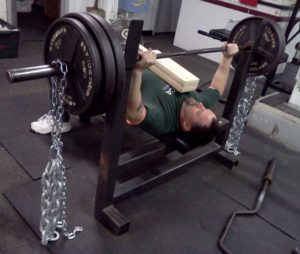
The names for these exercises are not flowery. A flat bench press is done on a flat bench. It’s the exercise that most of us associate with big muscular men pushing 300 pounds.

Benefits of the Bench Press

Thanks to Mike Pastva for the photo.

You lie flat on the bench, feet on the floor, unrack the bar, push it up, bring it down to your chest just below your breasts and then push it up again.

You can build muscle doing this but don’t be afraid to start with just the bar. You want to make sure you can do it before you start adding weights to the bar.

If you begin to add weights to the bar, be sure to get someone to spot you. That’s the hard part for me because I don’t usually have someone to spot me unless I’m working with a trainer.  I could probably find someone working out who wouldn’t mind so I need to just ask for that help.

I started with just the bar and did a set of 15 reps. I then added five pound plates and did another 15. Then I went to ten pound plates, and then both the five and ten pound plates. I ended up with 25 pounds on each side. The bar weighs 45 pounds so with an additional 50 pounds (the 25 on each side), I pressed about 95 pounds. I needed some help with that last set though so I’m not really there yet.

Inclined Bench Press

For this press, you raise the bench a bit. You can start with the bench at a higher angle and then as the weight that you lift goes up, you can lower the bench a bit.  So you might start with the bench at a 45° angle and end with it at a 10° angle. I just lower it down a notch at a time.

I use dumb bells when I do the inclined bench press. I’m sure you can use the bar instead but the dumb bells make me work both arms just a bit more. At least, that’s how it feels to me.

Here’s my workout:

I start with lighter weights. Right now, for me, I start with 10 pound dumbbells and do a set of about 15. Then I begin to work my way up the weights and as the weight goes up, my reps go down. Needless to say, since I start at 10 pounds and, if I have someone to spot me, I go up to 30 or 35 pounds, I end up doing about five sets. If I don’t have someone to spot me, I stop at around 25 pounds and just do a couple sets with that.

I worry that if I go too heavy on my own, I’ll have an accident.

Non-Bench Press

You can do a dumb bell or kettle bell press without using a bench. In my boot camp class, we’ve been known to lie on the floor and do a press. I’m not sure why we do that except that lying on the floor doesn’t allow you to drop your elbows any lower so perhaps that’s it. That and, of course, there are no benches in the gym.

I’ve done a press using a large physio ball. Balance on the ball, plant your feet firmly on the ground and press the dumb bells up and back down.

Benefits of the Bench Press

The bench press really works your upper chest muscles (your pecs). We’re not going to look like some muscle man but it does make you look a bit better to have stronger chest muscles.

I’ve read that working the chest muscles does help prevent sagging breasts. I think that’s worth considering. I don’t know if this can overcome already saggy breasts.

The bench press also works your arm muscles. I definitely felt it in my triceps later.

Just like all strength training, the bench press is good for bones, joints, ligaments, and tendons.

Finally, you will feel impressive, like Elli, in the gym when you start to bench press.

Cautions

If you’ve never done a bench press, ask a trainer at your gym to help you get started. It’s not a complicated exercise but it’s worth getting some advice when you start.

I’m not a trainer or a physical therapist so I can only tell you what I’ve read and what I’ve done. If this hurts or is too hard, work up to it. There are certainly plenty of other exercises that will work the chest muscles so try those if you don’t like the bench press.

Talk to Me!

Do you bench press? If so, what do you do? Share your secrets! If you don’t, do you want to? Share your thoughts with me. Leave a message below or email me at jill@becomingelli.com. You can also leave a voicemail message at 330-970-6662.


Five Ways to Track Your Fitness Progress

Regardless of where you are in your fitness journey, it’s a good idea to track your fitness progress. It can make you feel proud of your accomplishments or make you realize that maybe taking that month off wasn’t such a hot idea.

You may feel like you just know where you are but I think most of us don’t realize how we’re actually doing. This is where it pays off to track your fitness progress.

Take Measurements.

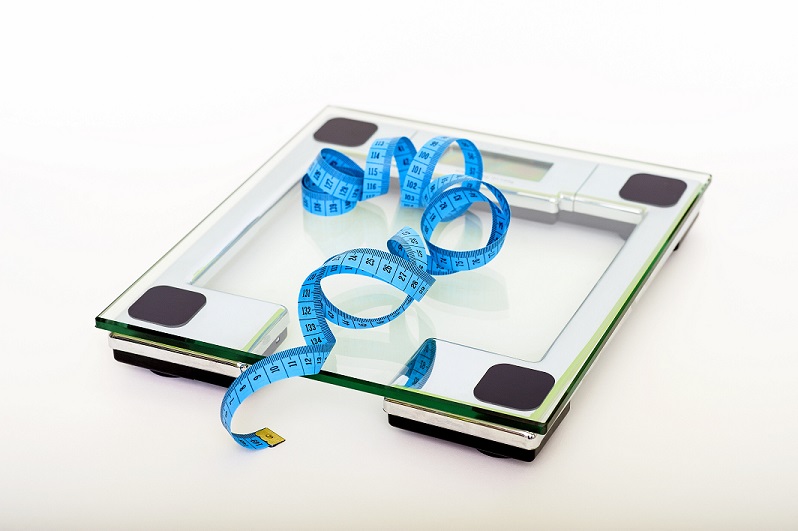
I’ve discussed the value of measurements before. I really like being able to see how I’m doing. I have a journal where I track my weight. I also include my measurements every few weeks. It’s a good idea to get a measuring tape and measure your waist, hips and maybe your thigh. Other parts of your body are difficult to measure on your own but if you have someone to help, you could throw in measuring your chest and your biceps.

track fitness progress

You certainly don’t need to measure every day but maybe once a month, look and see where you are. Even changing by half an inch may be a great sign of progress.

This might be where you track other measurements too. This can be numbers provided by your doctor from blood work or tracking your blood pressure or resting heart rate.

Take photos

Many of us hate to have our pictures taken, especially when we’re wearing our workout clothes. I urge you to get over that and take pictures of yourself. If you’re doing a selfie, you want to try to get most of your body in the shot so you may need to use a mirror for the shot.

Save your photos from races and group runs or group fitness events.

Again, photos can be motivating because you may see progress or you may see backsliding. You know that old saying, cameras never lie. Of course that saying is definitely old because now with PhotoShop and filters and everything, many photos do lie but try to keep the originals so you can track your progress.

Write Down Your Strength Workouts

I love weight lifting. If I could only choose one thing to do, I suspect that I would opt to just lift weights. One reason I like weight lifting is that it’s so easy to track your results. Why? Because you’re lifting WEIGHT and it’s easy to measure.

Today I did deadlifts in a fitness class and my max was 105 pounds. Now I know that last year I deadlifted 150 pounds so it’s easy for me to see that I either was slacking today or have lost some strength. I suspect that it’s a bit of both.

If you lift weights, keep track of your sets and what you’re actually lifting. Over time you can see how you’re gaining strength.

Record Weight and Body Fat

This is similar to taking measurements. Jump on a scale periodically. We’ve talked about weighing ourselves every day but many people dislike that. I suggest that you weigh yourself regularly and record it. It’s an easy way to see what your body is doing.

Perhaps more importantly is to track your body fat if you can. I get this checked at my gym every so often using a hand-held device.

Many scales are now available that also provide you with body fat numbers. I know many say that these scales aren’t accurate but I think they’re great for watching trends. As long as you’re using the same scale, you can see if that percentage is going up or down.

Test Yourself

Once a month or so, test yourself. See if you can lift more weight or do more reps in a set. You can do something like set a timer for a minute and see how many push ups you can do. Or you can do the opposite and do 20 burpees and track how much time it takes. If you do this regularly, you will probably begin to see improvements. You might get to the point where you think, “I hate doing 20 burpees” and then you’ll know it’s time to change the test.

Track Your Fitness Progress

It pays to track your progress. Whether it’s seeing that you’re an inch smaller at the waist or that you can do 3 more push ups than you did last month, it’s motivating to know that you’re improving.

Be sure to write this information down because, trust me, you won’t remember the details.

If you’re on this fitness journey long enough, you’ll eventually have photos going back years and that is invaluable.

Let me know if you do any of these things or if you’re going to add them to your routine. I’d love to hear how it works for you.

My Fitness Routine – Improving Strength, Flexibility, and Balance

Since I’ve been cleared to resume exercising, I’ve been struggling to come up with a fitness routine that works for me. I want to return to some of the things I’ve enjoyed doing but I also want to avoid injuring myself. I’ve decided I need to work on core strength, flexibility, balance, and variety.

I’m hoping that working variety into my fitness routine will help me avoid injury and any kind of repetitive stress problems.

I’ve come up with a fitness routine that is working for me right now. Of course, it’s still winter in Ohio so I’m not getting outside very often. This routine might change once spring and summer arrive.

I also find that if I assign certain days to certain exercises, I’m likely to get it all done.

Fitness Routine


Sunday

Sunday is now my upper body strength day. I asked my boyfriend to work with me on regaining my upper body strength so we now hit the gym on Sunday and use the dumb bells and equipment. It’s a challenging workout, that’s for sure. Last week, we did a lot of chest presses, flies, triceps dips, and some ab work. I felt it the next day, that’s for sure.

Monday

Monday is now my yoga day. I found a class I like at a rec center at a nearby town so I bought the non-resident passes and try to go every Monday evening.

If I can’t make it because of a scheduling conflict, I try to work some cardio in its place. That might be running or using a bike at the gym.

Tuesday

I’m now attending a Pilates class on Tuesday mornings. I’ve just started back into Pilates reformer classes and it was quickly apparent that this is a good thing for me to do.

The instructor commented on how tight my ham strings and calves are. I knew that of course but rteally haven’t found a solution. Hopefully, Pilates will help.

Wednesday

I meet my trainer on Wednesday late afternoon. She tends to give me a full-body workout that challenges me. She focuses on strength, balance, and cardio conditioning by elevating my heart rate.

Sometimes after my training session, I’ll add a brisk walk or a run or I go swimming.

Thursday

Thursday is my catch up day. I tend to do some kind of cardio. Since I want to swim at least once a week, this might be my swim day. If not, I’ll go for a run.

Friday

I see my trainer again on Friday morning. We do something that complements what we did on Wednesday.

Once in a great while, I treat myself to a orthopedic massage. An orthopedic massage is not necessarily the most pleasant massage. It’s not like a relaxation massage. Instead, it works on injury rehabilitation and improving range of motion. If I get a massage, I try to get it on Friday so I go into the weekend feeling better.

Saturday

I haven’t returned to my boot camp class yet, which is on Saturday morning. Instead, I’ve been riding a bike or running at the gym.  I look at what my fitness routine has been this week and Saturday becomes the day that I try to fill in whatever I’ve been missing.

The one thing that I’m struggling with right now is that my daily steps have dropped. That’s due to a change in my living arrangements and I’m just not getting in as many steps as I used to in doing my daily activities. I need to figure that out because while having some physical activity is important, so is getting in those steps. That’s next on my list of things to figure out.

I’m happy to have worked out a fitness routine that works for me. Of course, this will change when I can begin to go outside. For example, my Sunday activities will probably change when the weather improves. When that happens, I’ll adjust what I’m doing and figure out how to keep the variety going.

Five Strength Building Body Weight Exercises for Women Over 50

I have been trying to focus on building a strength exercises in my workout routine.

We know that as we get older, the body naturally loses muscle tone, so my strength routine is an attempt to keep my muscles toned and functioning correctly. For whatever reason, I find it much easier to go to walking, running and cycling which are more cardio based.

I like strength exercises that use weights, but sometimes just using body weight is enough of a challenge. Because I am looking for more endurance and resiliency, I tend to really love strength work outs.

Keep Good Form with Bodyweight Exercise
As with all exercises, form is critical to making it work your body and not to injure yourself. When learning these, it’s good to use a mirror to check and make sure form is good. (Always check with your doctor if you are new to exercise or aren’t sure these are good for your body’s situation, like if you’ve had a previous injury.)

Sometimes I like to do variations to mix it up. It helps me from feeling bored. But other times I prefer to time myself to hold the position for a longer time before moving on to the next exercise. If some of these seem too easy to you, try a different one. If you find you can only do them for just a few seconds, over time, as your strength builds up, you will find you can hold the position for a longer time.

Here are five exercises that seem simple because they are holding your body weight. Each one has modifications to make it less or more challenging.

  1. Bridge – One Leg Bridge – Marching Bridge
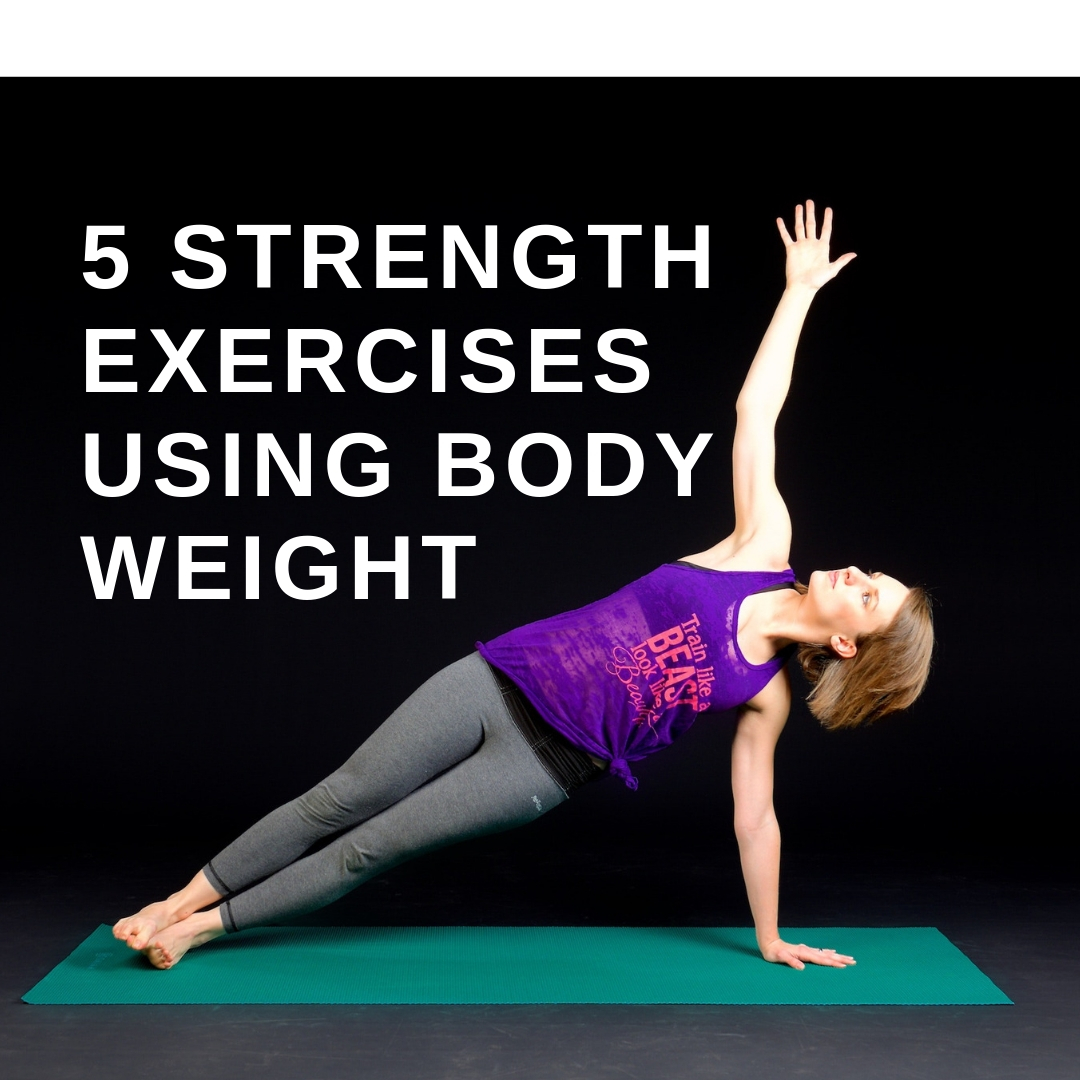
  2. Plank – Elbow Plank – Straight Arm Plank – Up Down Plank – Side Plank – Toe Touch Side Plank
  3. Cat/Cow – Bird Dog on Knees – Bird Dog on Toes – Bird Dog with Elbow Crunch
  4. Wall Sit – One Leg Wall Sit
  5. Calf Raise – Single Leg Calf Raise – Calf Raise and Hold – Single Leg Calf Raise and Hold

Most of these body weight strength exercises listed above are isometric, meaning you hold your body in a position.

Advantages of Isometric Strength Exercises
Isometric strength exercise helps build stamina. Another advantage is that these types of exercises are easier if you have arthritis or ligament injury. And you don’t need any equipment. You can do them almost anywhere when you have a few minutes.

Although these exercises won’t help you build speed, they really do help with strength and endurance. It is so important to add strength to an exercise routine for women over 50 to keep fit and active.

Do you have a routine of body weight exercises that you do regularly? Which one are your favorites? Which exercises would you rather skip? Let us know by leaving a comment below.

« Older posts Newer posts »

© 2026

Theme by Anders Noren — Up ↑