Page 18 of 65

Not Your Average Runner with Jill Angie

Episode 113 – Not Your Average Runner with Jill Angie

Download | Play in New Window
Please Subscribe: Apple Podcasts  (iTunes) | Google Podcasts | Android-Google Play | Stitcher | Player FM | Castbox | Tunein | Spotify | RSS

In episode 113, Jill and Chris interview certified running coach and personal trainer Jill Angie.

Jill Angie is the author of the book, Not Your Average Runner; Why You’re Not Too Fat to Run and the Skinny on How to Start Today. She has also published 5K and Half Marathon training plans for beginning runners.

She hosts the “Not Your Average Runner” podcast and website to show that runners come in all shapes, sizes, and speeds. She wants to live in a world where everyone is free to feel fit and fabulous at any size. Jill and her coaches help women to start running or to improve their running.

In this episode, we discuss:

  • Mindset and her Not Your Average Runner philosophy
  • Cross training
  • Running equipment – bras, shoes
  • Joints – misconceptions about running hurting your knees
  • Coaching women who feel they are too old, too fat or too slow
  • How she helps women start running with the body they have now

Links:

FAQ Ask Us Anything with Chris and Jill

Episode 112 FAQ – Ask Us Anything with Chris and Jill

Download | Play in New Window
Please Subscribe: Apple Podcasts  (iTunes) | Google Podcasts | Android-Google Play | Stitcher | Player FM | Castbox | Tunein | Spotify | RSS

In episode 112, Chris and Jill answer frequently asked questions from listeners and women over 50 in the Becoming Elli Community.

In this episode we discuss:

  • Getting started with Strength Training
  • The importance of Light and Sleep
  • Recipes for Sheet Pan Dinners, Instant Pot, Grilling
  • Summer Exercise

Links mentioned:

Have any comments about this episode? Or do you have a question that you’d like discussed on the Fit Strong Women Podcast? Please leave a comment below or email us at Chris @ BecomingElli.com or Jill @ BecomingElli.com. We’ll do our best to add this to our future podcasts. Looking forward to hearing from you.

Zucchini Casserole Recipe from Marcia Allen

Looking for a delicious zucchini casserole recipe? A few weeks ago I mentioned that my zucchini plants were doing well. Wow, the zukes are coming in strong now.

A special thank you to Marcia Allen who posted a couple of great recipes in the comment sections of that post yesterday.

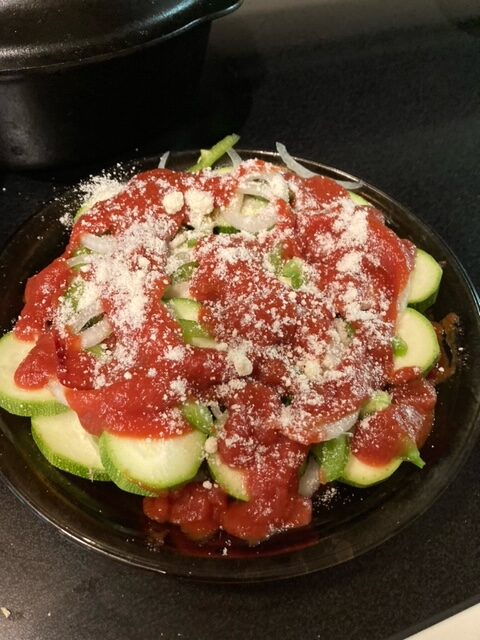
I tried the casserole and am posting my step by step photos here. Immediately I realized I don’t have the right cheese (Shredded Parmesan or Asiago Cheese), but I did have just a bit of a sprinkle of Parmesan cheese to add to it. When I make it again, I’m going to use the right cheese because I know it’d be even better!

First I cut the zucchini into round slices, zucchini casserole slicesThe sprayed some olive oil onto the bottom of a glass round pie plate and added some marinara sauce and then laid in the slices.

Then I sliced very thin slices of a sweet onion and a green pepper to top the zukes.

Added more sauce to the Zucchini Casserole and repeated with more zucchini rounds, onions and peppers.

Topped with more sauce and then the sprinkle cheese.

Baked at 350 for 45 minutes.


Delish!! This is also a great veggie challenge recipe too, if you’re challenging yourself to add more vegetables into your meals.

Taking Responsibility for Your Life with Renée Suzanne

Episode 111 Taking Responsibility for Your Life with Renée Suzanne

Download | Play in New Window
Please Subscribe: Apple Podcasts  (iTunes) | Google Podcasts | Android-Google Play | Stitcher | Player FM | Castbox | Tunein | Spotify | RSS

In episode 111, Jill and Chris talk with Renée Suzanne, who is a special kind of coach. She helps women with self awareness and self confidence, persistence, positive mental attitude, self love and acceptance.

Renée Suzanne helps women over 40 start dating better men immediately so they can meet and marry the man of their dreams. She is the creator of the COURTED method, a process that helps women date in order to create the lasting connection they really want.

Renée is the author of “Beloved: How to go from relationship-challenged to relationship-ready” and “Ten things you can do to upgrade your love life”. When she’s not helping women find true love, she is out ballroom dancing with her husband or walking her dog on the trails near her home in Chicagoland.

Her coaching principles for improved dating reach into many areas of reaching goals.

Ways you can begin taking responsibility for your life:

  • Identify what you want
  • Articulate your desired goal – it’s a big step to admit you want something
  • Own it and commit to yourself
  • Do it – Take action
  • The more you get into it, the more you can stretch what is possible
  • Things become possible that you never would have considered.
  • The power of progression
  • Really love yourself and have your own back

Links:

Website Renée Suzanne Coaching
Kindle book on Amazon Beloved: How to go from relationship-challenged to relationship-ready
Kindle book on Amazon Ten things you can do to upgrade your love life

Strength Training Guidelines

We’ve talked a lot about strength training guidelines for adults on our podcast. I thought I’d provide a quick recap of those guidelines and give you some ideas on how to get in quality strength workouts.

Strength Training Guidelines

According to the American College of Sports Medicine (ACSM), healthy adults should perform strength training at least twice a week on non-consecutive days. Each session should include 8 to 10 repetitions that stress each of the major muscle groups or 10 to 15 repetitions for those who are older and frail.

If you go with longer repetitions, you’ll use lighter weight.

You can certainly train more than twice a week but you want to make sure you cover all of the major muscle groups at least twice a week. So, perhaps you do upper body and alternate with lower body twice a week. That gives you four days of strength workouts.

Major Muscle Groups

If we’re supposed to train every major muscle group twice a week, we need to know what they are. Plan on training these parts of the body:

  • Chest
  • Back
  • Shoulders
  • Arms:
    • Biceps
    • Triceps
  • Abdomen
  • Legs:
    • Quads
    • Hamstrings

Benefits of Strength Training

Why should we strength train at all? Isn’t it sufficient to just walk 10,000 steps every day?

The ACSM describes a variety of benefits of strength training. They are:

  • Maintain muscle or fight the loss of muscle mass
  • Prevent osteoporosis
  • Decrease the risk of heart disease
  • Decrease the risk of falls or the likelihood of injury if you do fall
  • Increase quality of life

Examples of Strength Training

You often hear strength training also referred to as resistance training. The goal is to put your muscles under tension using resistance. You can do that with weights like dumb bells and kettle bells, resistance bands, machines at the gym, or body weight exercises.

Examples of typical resistance exercises that can be performed using free-weights, machines, or body weight for the major muscle groups are:

  Free-Weight Machine-Based Body Weight
Chest Supine Bench Press Seated Chest Press Push-ups
Back Bent-over Barbell Rows Lat Pulldown Supermans
Shoulders Dumbbell Lateral Raise Shoulder Press Arm Circles
Biceps Dumbbell Curls Cable Curls Side planks
Triceps Dumbbell Kickbacks Press downs Dips
Abdomen Weighted Crunches “Abs” Machine Crunches Prone Planks
Quadriceps Back Squats Leg Extension Body Weight Lunges
Hamstrings Stiff-leg Deadlifts Leg Curls Hip-ups


If you aren’t sure how to do any of these, there are lots of demonstrations available on YouTube and a variety of strength training apps.

Don’t forget that the ACSM also recommends that you get in some cardio workouts during the week. I’ll write that up in a future post.

Daily Habit Change with Colette Harris

Episode 110

Download | Play in New Window
Please Subscribe: Apple Podcasts  (iTunes) | Google Podcasts | Android-Google Play | Stitcher | Player FM | Castbox | Tunein | Spotify | RSS

In episode 110. Jill and Chris talk with Colette Harris about how she transformed her health and body with nutrition and lifestyle changes.

After she was diagnosed with Lipoedema and Fibromyalgia, Colette searched for recovery beyond pain medications. She made a series of daily habit changes over the course of several years to eliminate refined carbohydrates and sugar.

She tells about her experience in reducing inflammation, eliminating pain and finding a healthy lifestyle.

Daily Habit Change with Colette Harris

“Making small habit changes each day add up to BIG change.”

Colette is a health coach who lives in Lochwinnoch, Scotland and helps others with sugar detox and lifestyle transformations. She was in the U.S. Navy Reserves and enjoys traveling the world.

We discuss Daily Habit Change:

  • Lipoedema is not rare, 11% (predominately women) have it.
  • Genetic, thick legs, stress and hormone changes (puberty, pregnancy or menopause generally) bring it out.
  • How CBD oil helped with fibromyalgia pain
  • How she was able to detox from sugar with a 90 day program in 2020
  • What she eats now to maintain her health
  • Why detoxing in a community is more successful than trying to white knuckle it alone
  • It’s not just what you put in your body but also on your body.
  • Infrared sauna
  • Brown fat versus white fat.
  • Wim Hof breathing method
  • Vibration plate
  • Habits, discipline, motivation – it all takes much longer than 21 days and how little rewards (non food) work
  • Jon Gabriel meditation 10 minutes a day transformation
  • Freeze/Fawn response vs Fight/Flight or Rest/Digest

Daily Habit Change website: https://www.dailyhabitchange.com/

Instant Pot – Cabbage and Onion

I should start by saying I love a cabbage and onion mixture!

It’s been a while since I pulled out the instant pot and used it to cook anything. The other day I noticed I still had a lot of little onions and a big cabbage that had been sitting in the refrigerator since the last grocery shop. I hate it when I spend good money on fresh produce and then let it get into old produce! The flavor is always compromised. I decided to saute the onions in a bit of olive oil. They were small onions, about golf ball size, so I just peeled and cut in half before lightly sauteing.cabbage and onions in the instant pot

Then I rough cut the cabbage in both directions and thru it into the instant pot. I also found a green pepper that was just a little past its prime, so I cut that up and added it to the pot.

cabbage and onion in the instant pot

cabbage and onion in the instant pot

Pretty Mushy Cabbage and Onion in the Instant Pot

cabbage and onions in the instant pot After I threw the onions into the mixture, I set the pot for 10 minutes on high. It took another 10 to 15 minutes to release the steam. So although it’s called an instant pot, it was more like 25 minutes total. The cabbage and onions were really cooked through. I think next time I’ll try only 8 minutes on high pressure to see if there is a little more crunch.

It’s been my experience with my instant pot that most everything is suitable for a soup after I get done with it. While that wasn’t my intention originally, the mixture of cabbage, onion and little bit of green pepper was great! Do you use your instant pot during the summer? Or are you more likely to use an air fryer? Let me know in the comments below.

Differences Between Dynamic and Static Stretching

In our podcast episode with Carol Simpson, she talks about dynamic and static stretching. She commented that you often see runners at the beginning of a race doing static stretches when they should be doing dynamic stretches.

Shortly after that episode, I went to my gym and they had a flyer out entitled Flexibility Guidelines for Seniors. I really hate applying guidelines for seniors to me but there was some useful information, mainly describing the differences between dynamic and static stretching.

Dynamic Stretches

Dynamic stretches involve movement. You move your joints and muscles so they go through a full range of motion. These stretches should be done before a workout to warm up the muscles.

Sometimes dynamic stretches are movements that mimic the movement of the exercise. That’s why you see swimmers circling their arms before a swim or golfers imitating a golf stroke without the club.

Dynamic stretches are about movement and the stretches are not held for any length of time.

Some examples of dynamic stretches are:

  • Hamstring sweeps
  • Arm circles
  • High knees
  • Jumping jacks
  • Side shuffles

Because the function of dynamic stretches is to warm the muscles, these are not the stretches to do after a workout. That’s when you want to use static stretching.

Static Stretches

Static stretches are when you stretch a muscle to its furthest point. You hold this position for a period of time. You might hold a stretch anywhere from 10 seconds to 60 seconds.

Static stretches are usually performed after a workout when your muscles have been warmed up. These stretches help to stretch out those worked muscles.

Some examples of static stretches are:

  • Toe Touches
  • Knee to chest
  • T-spine rotation

Basically, name a body part and stretch it. You can do a neck stretch, a triceps stretch, a quads stretch. Any of these things help the worked muscles. The static stretches help you recover from your workouts.

Let me know what stretching you like to do.

Eating Zucchini from the Garden

I love fresh vegetables from garden, especially zucchini from the garden!

It’s fun to watch them grow and I don’t think you can eat much more local than that.

This year three little zucchini plants have really done well and I anticipate I’ll be making zucchini quite a bit later this summer. I’ve asked some friends in the Becoming Elli group to share their recipes me with because it’s easy to get too repetitious with a recipe.

If you’ve ever grown zucchini, you probably know that it all ripens at once! Although some of the ends of my baby zucchini have been nibbled by a deer, I don’t think they liked it because it wasn’t gone.  The deer have really feasted on the cucumbers, but I’m hoping the zucchini make it thru during the next few weeks. If they do, I will probably have between 15 and 20 zucchinis to make into something.

My usual way of eating zucchini when it comes in by the boat load:

  • zucchini bread (delicious, but of course, my recipe is with flour and sugar, so not the most healthy)
  • sliced rounds roasted in the oven with a little olive oil
  • zucchini spears diced in my favorite salad with vinegar, olive oil, dill and basil
  • shredded zucchini

I’ve heard of zucchini lasagna, but I’m not sure I’ve ever made it. It’s probably much like eggplant lasagna. Basically, you substitute sliced vegetables for the pasta noodles.

Please leave a comment below with a zucchini recipe that you enjoy. I appreciate it!

Hydration Guidelines

I found some hydration guidelines at my gym and I thought I’d share some of the information.

How Much Water Should I Drink?

You’ll see a wide variety of numbers for water requirements for healthy adults.  When I searched for hydration guidelines for adults and found a range of recommendations.

I saw that we should drink eight 8-ounce (just shy of two liters) glasses of water per day. I saw higher and lower numbers too.

You can find calculators online that will take your weight and tell you how much water you need to consume. I found one that seemed to be hosted by some diet blogger. It said I should drink 119 ounces of water per day, which is the same as 14.9 Cups or 3.53 Liters). That seems excessive.

I’m not going to recommend a particular number but I know that I don’t drink as much water as I should. I think if you started with the 64 ounces (eight 8-cups), you’d figure out if you need more or less.

It is possible to drink too much water so don’t get carried away with your water consumption.

Benefits of Drinking Enough Water

Why should we care about how much water we consume each day? What’s the big deal?

Here’s a list of benefits that Harvard Health Publishing put out:

  • carrying nutrients and oxygen to your cells
  • flushing bacteria from your bladder
  • aiding digestion
  • preventing constipation
  • normalizing blood pressure
  • cushioning joints
  • protecting organs and tissues
  • regulating body temperature
  • maintaining electrolyte (sodium) balance

I can think of a couple of more benefits. Drinking water helps make your skin look better.

I’ve also read that drinking water can help you to lose weight.

Signs of Dehydration

The most obvious sign of dehydration is that you’re thirsty. Sometimes though, we don’t have enough fluids in our bodies and we aren’t necessarily aware of it.

Here are some signs:

  • Dry mouth and tongue
  • Irritability
  • Dark urine
  • Fatigue
  • Dry skin

I just want to point out the irritability sign. Sometimes we are dehydrated, we get cranky. But sometimes when we have eaten, we get cranky. You might try drinking a glass of water before you reach for a snack.

How to Drink More Water

Now that we’ve discussed hydration guidelines and how to tell if you’re dehydrated, lets talk about how we can increase how much we drink.

Add pieces of fruit to your water. There’s the traditional lemon slice, which I like, but you can add other fruits as well. Other citrus fruits work well, as do strawberries and perhaps other berries too.

Drink water as part of your routine. Perhaps you start every day with a glass of water. Or every time you eat a meal, you also drink some water. Make water part of your daily habits.

Replace carbonated and sugary drinks with water. I suggest getting some sparkling water as a replacement. I bough a case of Perrier at Costco and I actually consider that water to be a treat, especially when I pour it into a goblet or wine glass.

Get a water bottle that tracks your progress. I’ve seen some very large water bottles out there.

Here’s something I’ve used to track my water and to be honest, I think that it was Chris who gave me this idea. I noted the size of my water bottle and then decided how many times I would need to refill it to reach my goal. If, for example, I need to refill it four times per day, I put four rubber bands around the bottle. When I filled it, I removed a rubber band. If I removed all four rubber bands, I knew that I had drunk my water for the day.

Don’t forget that some foods have a lot of water in them. Watermelon is probably the most obvious one but most fruits have a lot of water in them. Some vegetables, for example, cucumbers, are a good source of water. Also, if you drink milk, there’s water in it.

Hydration Guidelines when Exercising

I try to always have a bottle of water with me when I exercise. If nothing else, taking a drink gives me a break when I’m working out hard.

Exercise increases our need for water. Here are the American Council on Exercise (ACE) recommendations:

  • Drink 17 to 20 ounces (about half a liter) of water two to four hours prior to exercising.
  • Drink 8 ounces (about a quarter liter) of water about a half hour before exercising.
  • Drink 7-10 ounces (about a quarter liter) of water every 10 to 20 minutes during exercise.
  • Drink 8 ounces of water no more than 30 minutes after exercising.

Conclusion

It’s helpful to know how much water you’re drinking and have a sense of how much water you want to be drinking.

How much water do you drink each day? Do you have any suggestions I didn’t list here? Let me know in the comments below.

« Older posts Newer posts »

© 2026

Theme by Anders Noren — Up ↑