Page 20 of 65

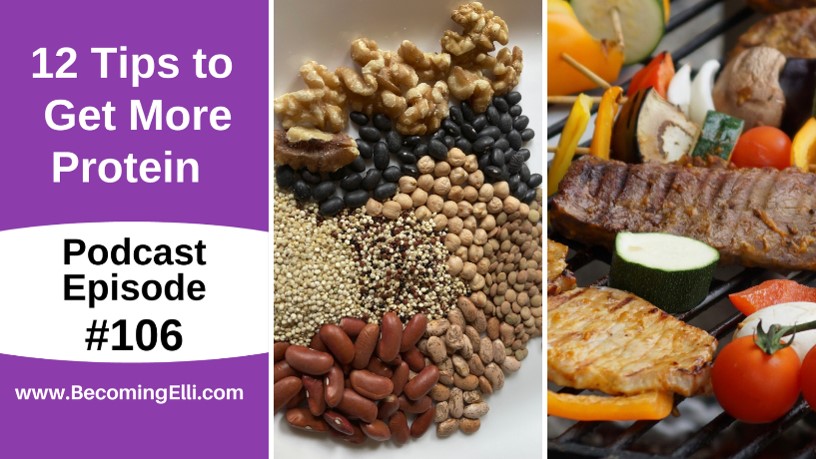
12 Tips to Get More Protein

12 Tips to Get More Protein – Episode 106

Download | Play in New Window
Please Subscribe: Apple Podcasts  (iTunes) | Google Podcasts | Android-Google Play | Stitcher | Player FM | Castbox | Tunein | Spotify | RSS

In episode 106, Jill and Chris discuss the importance of protein in the diet, especially for women over 50. They offer12 different ways to get more protein in your diet.

  1. When doing meal planning first figure out the proteins, then adjust for the veggies.
  2. Precook protein in a crockpot so you have a lot available ahead of time. Refrigerate to add to other meals.
  3. Precook quinoa when doing meal prep. Easy to sneak it into soups, salad, other meals. 20 grams of protein per serving
  4. If you are avoiding dairy use plant protein soy- based proteins like tofu tempeh lentils and beans
  5. When making a vegetable salad add in chickpeas kidney beans black beans quinoa even tuna
  6. Add sardines to your fish choices. Sardines make a great addition to tuna salad here is another recipe for sardines
  7. When you sit down to eat, start with eating your protein first
  8. Add Greek yogurt to your breakfast routine or dessert. Fage Greek yogurt 0% milkfat has 20 grams of protein in a serving
  9. Consider breakfast with eggs instead of cereal
  10. Use protein powder in smoothies Orgain is available on Amazon or at Costco with many choices of flavors. Great for smoothies adding into coffee as a creamer.
  11. Protein bars dash keep them handy for when you might miss a meal link to episode #38
  12. Try this protein oatmeal ball recipe

Hormone Health and Menopause with Karen Martel

Hormone Health and Menopause – Episode 105

Download | Play in New Window
Please Subscribe: Apple Podcasts  (iTunes) | Google Podcasts | Android-Google Play | Stitcher | Player FM | Castbox | Tunein | Spotify | RSS

In episode 105 Jill and Chris speak with Karen Martel, a Certified Hormone Specialist & Transformational Nutrition Coach and women’s weight loss expert.

Karen is the host of the top-rated women’s health podcast The Other Side of Weight Loss where she helps women to unlock the mysteries of female fat loss and hormone imbalance.

After struggling with her own health issues, Karen was determined to bring her knowledge to others with a bold new approach to women’s hormone health and weight management. Karen’s passion lies in helping women balance and optimize their hormones in peri and post menopause and breakthrough weight loss resistance.

She sheds light on many hormone health and menopause issues that may not be fully understood.

In this episode we discuss:

  • Thyroid hormones – T3, T4 and metabolism
  • Estrogen, DHEA, Progrestrone, Testosterone
  • Lymph nodes
  • Which hormones affect weight loss
  • The safety of taking bio-identical hormones

Links:

Karen’s Podcast: The Other Side of Weight Loss
Website: www.KarenMartel.com
Instagram

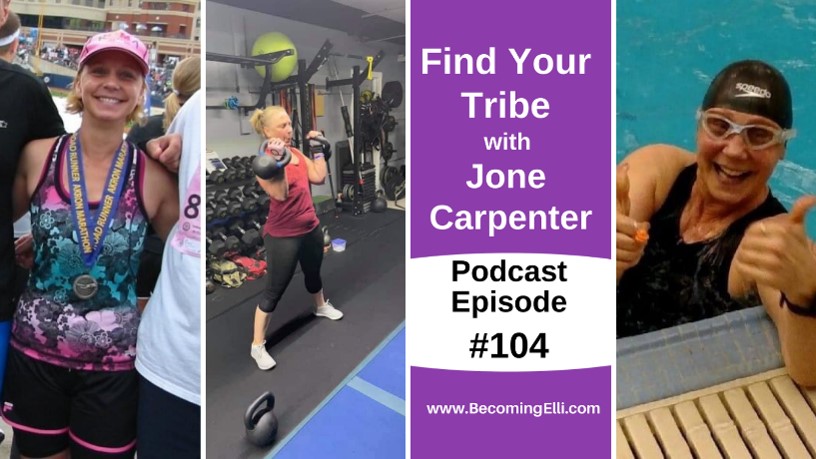
Find Your Tribe with Jone Carpenter

Episode 104 – Find Your Tribe with Jone Carpenter

Download | Play in New Window
Please Subscribe: Apple Podcasts  (iTunes) | Google Podcasts | Android-Google Play | Stitcher | Player FM | Castbox | Tunein | Spotify | RSS

Originally from rural southeastern Ohio, Jonella Carpenter, known as Jone, is both a mother and grandmother. She can often be found walking, running, or hiking in her local parks in all kinds of weather. Her attraction to the outdoors started when she was a kid (even the outdoor chores were fun for her) and grew as she became an adult.

In 2008, a friend suggested that Jone run a half marathon, and though she didn’t know what she was in for, she has never been afraid of a challenge. She toed the blue line of the Akron Marathon on a crisp September morning without training, and though she crossed the finish line three hours and forty-five minutes later, she couldn’t walk for days.

Needless to say, she learned quite a bit during that first race! Since then, Jone learned more about how to train, fuel her body, and stay motivated even when times were tough. As a breast cancer survivor, her body has been through significant changes but continues to be a way to explore nature, connect with friends, and challenge herself in a variety of ways. She even overcame a life-long fear of water to learn to swim in her 50s.

Among her friends and running buddies, Jone is known for always saying yes to any adventure (even the cold, muddy ones) and can often be found encouraging others (even strangers she’s met along the way) to keep moving. Through the miles, boot camp classes, swim lessons, and other adventures.

One key point of advice to women over 50 who want to be fit and strong: Find Your Tribe. Jone ran informal groups of friends calling themselves the Towpath Turtles or BCB – the Bad Choice Babes and works out at a gym where the group exercise inspires her.

During this episode we talk about:

  • Running races and training
  • Finding a group of like-minded friends, Finding Your Tribe
  • Lifting weights and cross training
  • Her experiences with breast cancer and running shortly after her mastectomy
  • Reframing your attitude to “I GET to do this” instead of “I HAVE or I SHOULD”
  • Learning to swim in her 50’s
  • How she listens to her body
  • Keeping muscle and protecting bones
  • Group cooking
  • Watching macros (using protein powder as a creamer)

Running and Grief

Is there a connection between running and grief? I think perhaps there is. Not for everyone, of course, but for some of us dealing with grief, running provides some mental health benefits.

There’s a lot of discussion about how running helps with our mental health. If you want to read a great memoir about this, check out Depression Hates a Moving Target by Nita Sweeney. Chris and I talked with Nita about running and mental health on our podcast. You might check that episode out too.

I don’t know if there’s much specific talk about running and grief, which is different than depression. Grief causes a lot of different emotions; sadness, anger, guilt, loneliness are a few. I think what makes running helpful is that it provides an outlet for all of that emotion stored up inside.

When my husband died, I felt bereft. I was angry that other women still had their husbands. I was lonely and worried about my teen-aged son and I felt completely unprepared for life on my own. Grief is an overwhelming emotion.

Shortly after my husband’s death, I began to go to the gym. I was overweight and out of shape because I’d been taking care of him for a couple of years and just couldn’t focus on myself. Once I started going to the gym, I used the weight machines and the cardio equipment, basically both the treadmill and the elliptical.

At some point, I decided that running would be helpful.

I don’t think I was thinking too much about getting in shape but I felt horrible and needed to do something. I downloaded a Couch to 5K app and began to try to run. I’d never been a runner before in my life, so this was a novel activity for me. Looking back, I can’t quite say why I decided to take up running. It just seemed like a good idea.

The act of running makes you think about something other than your day-to-day details. My mind would wander, and I’d be completely away from my sadness. You really have to focus on your body and what’s around you and less on what you’re feeling.

Also, getting better at something helped my mental state. I would do a particular week of my Couch to 5K and if I couldn’t move on to the next week, I’d repeat the current week. Eventually, I’d be able to move on. When I ran 30 minutes without stopping, I felt so happy with myself. That moment of success was fantastic.

Just the act of going outside to run helped. I put on running clothes of some sort and my running shoes and prepared to go out. Just having to do the prep work helped me feel better. I put together a play list and figured out how to have water handy. Those details were something different to think about.

I went to a grief support group for a while. A couple of women said that when their husbands died, they spent months in bed and never went out. That’s when I realized that we all grieve differently. I couldn’t

Losing a loved one is so hard. I’m not saying that running makes it better, but it makes facing life and grief just a bit easier.  There’s some time where you’re not focused on your grief but instead on how it feels to run.

Do you think running has helped you with grief? Or some other kind of fitness? I’d love to hear from you.

Ways to Get Started with Strength Training

One thing I’ve noticed in the Becoming Elli community is that many of us are looking for ways to get started with strength training. Many women who have joined the Becoming Elli Facebook group (it’s a private group and if you haven’t joined, please do so!) want to get started with strength training.

Most of us know how to do cardio exercises. We use the treadmill or the elliptical or we bicycle indoors and out.

If you listen to the Fit Strong Women over 50 Podcast, you know that we talk a lot about the importance of strength training for women as we age.

Why Strength Train?

We lose muscle more quickly than men and that loss begins earlier than we’d like to think about. Losing muscle makes it harder to keep our metabolism going at a good pace. It makes it harder to move. There are lots of reasons why we should be strength training, also called resistance training. We can go into those reasons in a different post.

There are lots of ways to do strength training, whether you belong to the gym or workout at home but we can all use some help in getting started. You can use weights such as dumb bells, kettle bells, and resistance bands. You can also use your own body weight doing things like squats, push ups, and lunges. Knowing what you can do is, of course, not the same as actually doing it.

Ways to Get Started with Strength Training

I’ve come up with a few ways to help get started with strength training.

Set Goals

Set goals with a timeline related to strength training. While long term goals are great, be sure to include some shorter term goals as well.

Perhaps your long term goal is to be able to do ten regular pushups. That’s a great goal but it may take you a while to get there so make some goals to hit on the way. Perhaps it’s to be able to do ten modified pushups. Then you can make a goal of being able to do one regular pushup. Finally, you hit that long term goal of ten regular pushups.

Invest in Yourself

I find spending money on something is a big motivator. If I pay for a training class, I’m much more likely to go. Perhaps you buy some new weight equipment to include in your home gym. Buying a kettlebell is sure a major investment. Or perhaps you pay to access a strength training app. Or you pay for personal training. Whatever it is, I think most of us do more when we’ve made a financial commitment to something.

Sure, people buy treadmills and gym memberships that they don’t use but I think if you combine the desire to get started with strength training with the financial commitment, you’re more likely to work at it.

Tell people what you’re doing

Tell friends and family member. Confide in your co-workers. If you’re open about wanting to get stronger, you’re more likely to get some support. It helps to tell people who also strength train or workout in some way. I remember telling my mother what I was doing and she really only walked. She told me I didn’t need to be doing this, that walking was enough. So telling your friend at your yoga class might be better.

Find support

Do you have friends who are also interested in strength training? If so, try to work out together. If that’s not possible, maybe try comparing workouts and giving each other ideas of things to try. Online communities, such as the private Facebook group for Becoming Elli, can be helpful. If you’re feeling overwhelmed, discussing with like-minded people can help.

If you’ve joined a gym, talk to the staff. There are people there who can show you how to do different exercises or how to use a piece of equipment. Take advantage of that resource.

Try to Improve

Look for ways to improve. I guess this might be related to goals but what I mean is, just be aware of your body and what you’re capable of doing. If last week, you could only carry two plastic bags of groceries, see if you can increase to three this week. If you can do biceps curls with 8 pound dumbbells, see if you can bump it up to 10 pounds.

Give It a Chance

Stay out of your head. Some of us start strength training say we don’t like it. The problem with that is we usually don’t want to do things that we dislike. If you work on having an open mind, you may realize after awhile that you’re actually enjoying yourself. Give it a fair trial. I really work on no longer saying, “I hate this” when doing squats.

Suggestions?

We know that strength training is important for us as we age so it’s important to figure out ways to get going with it.

What suggestions do you have? I would love to hear other ideas. Comment below if you have something to share.

The Path of Yoga and Meditation with Julie Norman

Episode 103 – The Path of Yoga and Meditation with Julie Norman

Download | Play in New Window
Please Subscribe: Apple Podcasts  (iTunes) | Google Podcasts | Android-Google Play | Stitcher | Player FM | Castbox | Tunein | Spotify | RSS

In episode 103, Jill and Chris talk with Julie Norman about her path of Yoga and meditation. Julie Norman delights in guiding others in experiences that foster growth and healing from a place of self-love. She believes this is essential for both individual and community wellness.

Her career as a registered dietitian in eating disorders treatment and her own recovery inspired the creation of Body Karma Healing (BKH), her signature program that guides women to peace with their bodies and food for authentic self-empowerment.

She’s the author of two books: Poems From The Path of Peace, Volumes 1 & 2 and The BKH and Goddess Wisdom e-courses. Julie is also a certified health coach, yoga teacher and equine specialist. She leads classes, workshops and retreats along with coaching individual clients, consulting and speaking on the topics she’s passionate about. In her free time she loves to travel, mountain bike and spend time with family, friends and pets.

We discuss:

  • Why is Yoga called a practice
  • The various types of Yoga
  • The benefits of Yoga
  • Tools used during different types of Yoga
  • Getting started with meditation
  • Her peace coaching at Body Karma Healing
  • Eating disorder and body image

Recipes mentioned in this episode:

Links to follow her online:

My Roasting Eggplant in the Air Fryer Experiment

If you Google how to roast eggplant in the air fryer, you will discover a lot of recipes. Trust me on that. I found lots of different recipes for roasting eggplant, even when I limited my search to using the Air Fryer.

I asked in the Becoming Elli Facebook Group (join us there if you haven’t already!) if anyone had any good ideas on what to do with eggplant. People made many suggestions so I have ways to prepare eggplant for a while. I also checked for other eggplant recipes in this site and found one recipe that Chris posted. It sounds good too so I may add that to my list of ways to prepare eggplant.

Roasted eggplant was one of the more popular suggestions so I decided to give that  a try. I love most roasted vegetables so I thought roasted eggplant would probably also be good.

Once I started researching the best way to roast eggplant, I found the one dividing point between cooks.  Salting the vegetable before cooking or not.

Eggplant has a lot of moisture in it. Typically if you’re making eggplant parmesan or some other Italian eggplant treat, you’re instructed to salt the slices of eggplant to draw out the moisture.

Some of the recipes for roasting eggplant insist the only way to get crips eggplant is to salt it first and remove the moisture. Other recipes said it doesn’t matter and you can skip that step.

The other discrepancy between the roasting methods was about removing the skin first. Some recipes said to peel the eggplant before cooking and other recipes said to keep it on.

To Salt or Not to Salt

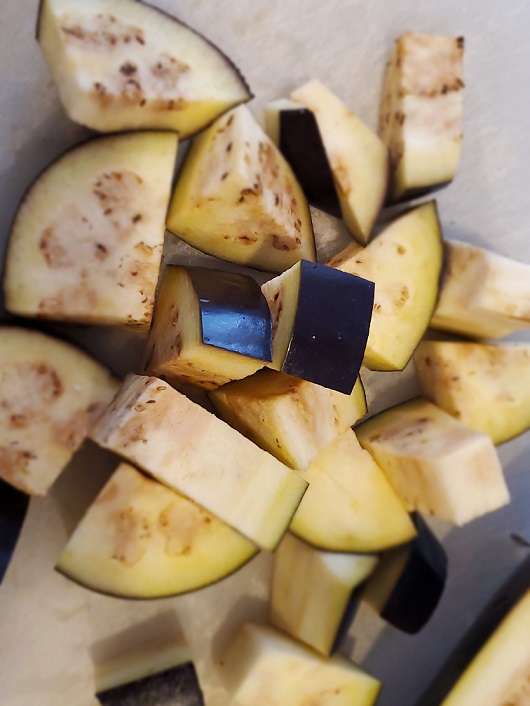
I decided to try both methods of roasting. I cut one eggplant into cubes and cooked half at a time.

To make sure I was conducting a fair experiment, I kept everything the same with both batches. I used the same oil and the same spices for both batches. However, I sprinkled salt on one batch and let it sit for about 30 minutes. The second batch I roasted without bothering with the salt.

I decided to leave the skin on the eggplant because my inclination with all vegetables is to leave the skin on if possible. For one thing, it’s a lot easier not to peel a vegetable before cooking. Secondly, it seems that for most vegetables, there’s more vitamins and fiber if you keep the skin on the vegetable.

Easier and better for you? Let’s try keeping the skin on the eggplant.

Roasting the Batches

For each batch of eggplant, I used about a tablespoon of avocado oil and then sprinkled on a mixture of spices. I used pepper, garlic powder, oregano, and a pinch of red pepper. Because I knew one batch would already be salted, I did not add salt to the spice mixture.

I roasted the first batch (the unsalted one) in the air fryer at 400 for about 15 minutes. I shook them up a couple of times while cooking. When they came out, the pieces were very dark so I thought I had burnt them. It turned out that they were fine but just had a dark color.

The second batch sat in a colander with the salt on for about thirty minutes. I stirred them occasionally to help remove any moisture. When I was ready to roast them, I wiped the salt and moisture off the eggplant chunks, and then prepared in the same way as the first batch.

I did cook the second batch for a couple of minutes less than the first batch. I thought I had burnt the first batch so wanted to try for a slightly shorter time.

Results

By the time the second batch had finished cooking, I had eaten most of the first batch. I forced myself to leave some so that I’d have them when the second batch finished. You can see in this photo how much I ate in the 12 minutes the second batch cooked. (The second batch is on the left. I know, they should have been on the right.)

The second batch was also good but did have a saltier flavor than the first batch. I was glad that I had not put any salt in the spice mixture.

I did not notice any difference in the crunchiness of the eggplant. Based on this small experiment, I would say you can safely skip the salting and wiping off part of the process.

And what about the skin?

The roasted eggplant became very soft so the only real crunch was from the skin. I really liked it. I thought the roasted skin added some great texture to the dish.

The result was that I ate an entire eggplant as a snack in the middle of the afternoon. It was delicious.

Roasting Eggplant in the Air Fryer

So here’s the simple recipe I used for the eggplant.

Ingredients

Eggplant

Oil

Spice Mixture. Use what you want for this but I used about 1 teaspoon each of oregano and garlic powder, ½ teaspoon of black pepper, and a scant 1/8 teaspoon of cayenne pepper.

Cut the eggplant into about one-inch cubes.

Toss them in about a tablespoon of oil. I used avocado oil but olive oil would work well.

Mix the spices together and then toss with the eggplant cubes.

Add the eggplant to the air fryer.

Roast at 400 for about 12 minutes. Stir at least once, halfway through the cooking.

These were good hot, right out of the air fryer, warm, and at room temperature.

They weren’t around long enough for me to try them on salad or any other dish.

I’m still open to other ideas for eggplant but I absolutely loved the roasted eggplant.

If you have any suggestions about roasting eggplant in the Air Fryer, other ways to cook eggplant or roasting other type of vegetables for me, be sure to share them with me.

Swimming Coach Amanda Boswell

Episode 102 – Swimming Coach Amanda Boswell

Download | Play in New Window
Please Subscribe: Apple Podcasts  (iTunes) | Google Podcasts | Android-Google Play | Stitcher | Player FM | Castbox | Tunein | Spotify | RSS

In episode 102, Jill and Chris talk with swimming coach Amanda Boswell. Amanda is a lifelong swimmer and coach who helps people learn to love the water and gain confidence in their swimming ability.

She works with people of all ages and different levels of swimming experience. Amanda’s clients have goals ranging from learning how to swim to training for triathlons. She competed in swimming through high school, but an injury kept her from moving onto college competition.

During college Amanda  began coaching and found that she loved being involved in the sport from a different perspective. Amanda holds a bachelor’s degree in Exercise Science from Miami University and a master’s degree in Sport and Exercise Psychology from Capella University. She is also a certified personal trainer with the American College of Sports Medicine.

“One of the best things about coaching swimmers is when they have that ah-ha moment, and everything clicks from their repeated hard work and determination, either with breathing or just being more efficient with their strokes. Training for a swimming event can be intimidating but with the right coaching and workouts, you can absolutely train to be your best in the water!”

During this episode, we discuss:

  • Learning how to swim as an adult
  • Advice for women who can swim but maybe not very well
  • Overcoming fears of deep water or open water
  • There and how to find a swim coach
  • Tools and props that are used in coaching swimmers
  • Various strokes and modifications for competing and racing
  • Why swimming is easier on the joints and ligaments
  • Improving swimming technique Increasing speed vs working on endurance
  • Swimming in a pool vs open water swimming
  • Fueling for swimming

Links mentioned during this episode:

This Is 50 with Angie Jackson

Episode 101- This is 50 with Angie Jackson

Download | Play in New Window
Please Subscribe: Apple Podcasts  (iTunes) | Google Podcasts | Android-Google Play | Stitcher | Player FM | Castbox | Tunein | Spotify | RSS

In episode 101, Jill and Chris talk with Angie Jackson about learning to swim and becoming at triathlete at age 50.

Five years ago, Angie decided to become a runner and then a triathlete. She tells us how she’s worked hard to learn to swim, bike, and run.

When she started her swim lessons again, Angie hired a triathlon Coach Morgon Latimore and successfully trained for and completed a Sprint, Olympic, and Half Distance Triathlon.

Angie Jackson has three adult children, and she is Mimi to her two grandchildren. Angie is a nurse and works long hours, but manages to fit in the training needed to race triathlons!

She is originally from Philadelphia and now lives in North Carolina. There are a lot of fun races that she will be participating in from now until then. Currently she is in training for her first full distance triathlon that will take place on Sept 17, 2022 in Maryland.

Some of the races she plans to do alone, but others she will do with her grandchildren.

Angie wants women to know we can change the narrative of what a certain age “looks or acts like.” Everything Angie is doing now: swimming, cycling running, yoga, strength training, and hula hooping…this is 50!

We discuss:

  • Learning to swim and being afraid of deep open water
  • Developing speed with intervals
  • Overcoming mental challenges by setting big goals
  • Getting encouragement in a community of like minded individuals
  • How she defines getting older and why she uses the hashtag #THISIS50
  • What type of fuel she uses for staying hydrated and fueled during the challenge of triathlons (INFINIT Go Far Endurance Fuel)
  • Her strength building routine
  • Angie’s challenging race goal schedule for the next 8 months, including the full IRONMAN in MARYLAND on Sept 17, 2022.

Links mentioned in this podcast:

Be You 4 Life Apparel – Angie is an ambassador Ambassador @BY4L (code anja 10)
Team Zoot https://teamzoot.com/
Infinit nutrition fuel  Ambassador @Infinit Nutrition (code Infinit-Jackson)
Angie Jackson’s Facebook
Angie Jackson’s Instagram

Winter Lunch of Cabbage with Ground Beef and Onions

Maybe because it is winter time, but I’m finding I really love a winter lunch of cabbage with ground beef and onions. Does anyone else like this type of thing? The cabbages in the store have been looking really great this time of year so I find them in my cart after many of my trips to the grocery store.

I may have written about cabbage with ground beef and onions in the past because it is one of my favorite winter lunches.

Making cabbage for lunch easy, full of delicious fiber and pretty healthy. If I was participating in a veggie challenge, this definitely would help me meet the days veggie goal!

First I slice the cabbage up, usually about a third of a nice sized head of cabbage. I cut it into the size of narrow cabbage steaks. sliced-like-cabbage-steaks

Then I turn the cutting board to run the knife thru the cabbage steaks in the other direction to make bite sized chunks.

run-the-knife-thru-the-cabbage-steaks

I cut an onion the same sort of way and put some olive oil in the bottom of my cast iron skillet. When the oil is a little bit heated up, I put the cabbage and onion in and let it brown on medium low heat. cabbage-in-the-skillet-with-onions-and-olive-oilSometimes I add some water so it doesn’t get too dry.

Before combining it with the ground beef, sometimes I remove the cabbage and onion mixture from the pan and brown the ground beef on it’s own.
Cabbage-with-browned-ground-beef-and-onionOther times, I just move the cabbage off to the side and brown the beef.
A little salt and pepper and my winter lunch of cabbage is ready to enjoy.

How about you? Are you one of those people who loves eating cabbage in the winter? Let me know how you prepare it! You can leave a comment below or send me an email at Chris@becomingelli.com. I look forward to hearing from you!

#cabbagerecipe #cabbagelunch #cabbageandonion #groundbeefandcabbage

« Older posts Newer posts »

© 2026

Theme by Anders Noren — Up ↑