When I read a story about a woman who is in the second half of life, who is knocking it out of the park, I get inspired!
I don’t about you, but I can’t do what I did when I was younger… but I can do different things now! And finding out about other older women who are working to become fit and strong is a big motivation.
When Jill and I first started Becoming Elli, we were inspired by Elli, the Norse Goddess of Aging, who beat Thor in a wrestling match. Aging is a funny thing. A lot of people complain about it. My 88 year old mom says, “It’s better than the alternative.” I am motivated by women who embrace it.
Every day I am inspired by reading articles, listening to podcasts and watching videos about real-life, older women who are doing amazing things like these:
Joan Benoit Samuelson, 61 years old, ran the Boston Marathon on Monday, finishing the challenging 26.2 mile course in only 3 hours, 4 minutes! When her time is adjusted for her age using the age-graded calculator, she actually won the Boston Marathon this year! She uses the power of story to motivate herself, and set her goal to run “40 minutes slower than 40 years ago” when she won with a finish of 2:35:15 in 1979. She mentioned she did a lot of cross training with Nordic skiing to improve fitness and strengthen her upper body without too much pounding on her legs.
Ernestine Shepherd, age 81, who started working out and exercising at a gym at age 56. Fulfilling a promise she made to her sister right before her sister passed away from a brain aneurysm, Ernestine achieved the world record as the oldest competitive body builder. She is a personal trainer and remembers the mantra from her sister, “Determined, Dedicated, Disciplined.”
Julia Hawkins, 102 years old, who took up competitive running at 100 and competitive cycling at 75 years old. Her children are in their 60’s and 70’s. She does a lot of work in her garden and runs inside when she hears the telephone ring.
What’s their secret? It’s hard to say, but in my opinion, they look forward, not back. They set little goals, then bigger goals. They stay active. They do what they can, when they can.
Exercising with other people is social. Competing helps to set goals. Trying new things helps me to not compare myself with what I did when I was younger. Becoming inspired by other older women makes me feel hopeful and motivated.
How about you? What motivates you? Do you know of another older woman who is doing something that inspires you? Let us know by sending an email: Chris@becomingelli.com or by posting on our social media!
Let’s talk about resistant starch. What is it? Why should we eat it? What do we eat to add it to our diet?
We had a mini-Becoming Elli outing a couple weeks ago and went to see a screening of The Gut Movie. The website adds a subtitle of A Story of Poo and the Future of Medicine. The documentary was an interesting look at research on the microbiome which is the microorganisms living in our intestines and the effect it has on our health. If you have the opportunity to see this movie, take it. I think we all learned something new from watching it.
Here on the Becoming Elli website, we’ve discussed the benefits of eating fermented foods for our bodies and our microbiome. In The Gut Movie, they talked about the benefits of fermented foods and resistant starch. I knew some things about this from reading some recent health foods but in our conversation after the movie, I realized that this is probably worth discussing.
What is Resistant Starch?
Resistant starch is found in carbohydrates that our digestive system doesn’t digest. Instead, this starch passes through the stomach and small intestine and ends up in the large intestine where all of that bacteria live. The bacteria, especially the good kind apparently, loves this type of starch and they digest it and release good enzymes to our bodies.
Eating resistant starch helps to prevent a number of health problems or helps our bodies deal with already existing health problems. Studies indicate that this starch may help to lower your blood sugar levels after meals and help to improve your insulin sensitivity. Because this resistant starch has lots of fiber, it can also help with weight loss and controlling appetite.
Where Do We Find Resistant Starch?
Some good sources of are:
Oats
Cooked oats provide some resistant starch but apparently cooking the oatmeal and then letting it cool increases the amount of starch. This makes me wonder if oatmeal cookies are a good source. If nothing else, my recipe for oatmeal balls suddenly sounds even healthier than I thought.
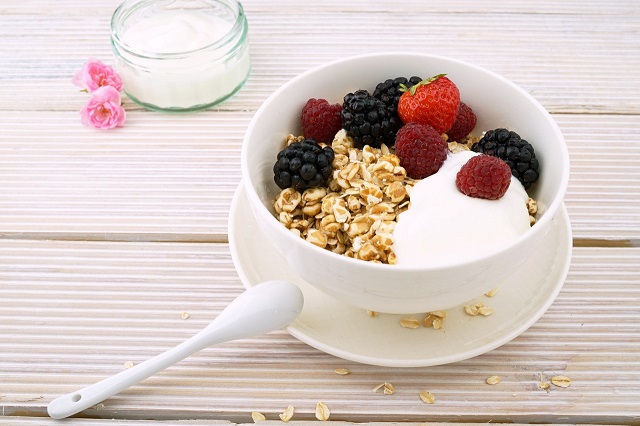
Raw oatmeal is also high in resistant starch so try making overnight oatmeal instead of cooking the oats. Overnight oatmeal is where you soak the oatmeal in yogurt or milk or nondairy milk overnight in the refrigerator.
Potatoes
The best way to get resistant starch from potatoes is to cook them and then to let them cool. Think potato salad. Or a cold baked potato, I guess, but that doesn’t sound appetizing to me. I think we need to add a good recipe for a healthy version of potato salad to the Becoming Elli website.
Raw potatoes also provide resistant starch. I remember loving to eat raw potato as a kid. I’d beg my mother for a slice of potato. Now, this doesn’t appeal so much to me. If this appeals to you, great. Otherwise, check out the raw potato starch described below.
Rice
Rice is similar to oats and potatoes. It needs to be cooked and then cooled to get the full amount of resistant starch. This makes sushi seem like a good source of resistance starch. I’ve read that you can reheat the rice without destroying the resistant starch.
I don’t think raw rice is an option.
Beans and Legumes
Make sure you cook your beans and legumes thoroughly. These are a good source of resistant starches and apparently you don’t have to cool the beans first to reap the benefits.
Green Bananas and Plantains
The greener the banana, the more resistant starch it has. I’m not a fan of green bananas but maybe try to eat them before they’re fully ripe. As the banana ripens, the resistant starch turns into sugars like fructose and sucrose.
Raw Potato Starch
You can buy bags of raw potato starch. It’s a flour-like substance that can be mixed into smoothies or drinks or added to foods such as yogurt. Don’t heat the raw potato starch so if you decide to add it to soup, do so after you’ve heated the soup. Basically, you treat this as a supplement to increase the amount of resistant starch you get. If you decide to use this, start slowly and gradually increase to 2 to 3 tablespoons per day. You want to avoid overwhelming your digestive system by adding too much too quickly.
Basically, the resistant starch and fiber are related so be sure to drink lots of water if you decide to increase your consumption of these foods. Also, start slowly to give your body time to adjust.
Have you been trying to increase resistant fiber in your diet? What’s working for you?
Spring has sprung! It’s getting warmer everyday here in Northeastern Ohio and I’m reminded that there are lots of spring running events and races.
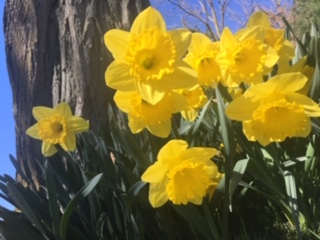
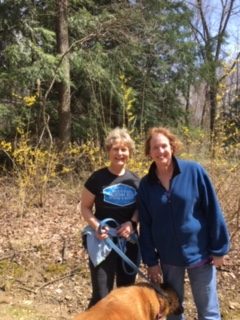
Jill and I took a hike along Daffodil Trail with my dog, Lady.
Jill wrote about her adventures in the annual Hop for Hope 5K run. Later this month I will be working a water station at the 6 mile marker for the Cleveland 10 Miler and, depending on my ankle and the weather, I will hopefully be competing again in the Raccoon Run.
If you’re looking for a race or running event near you, check out the Let’s Do This website to find something fun in your area.
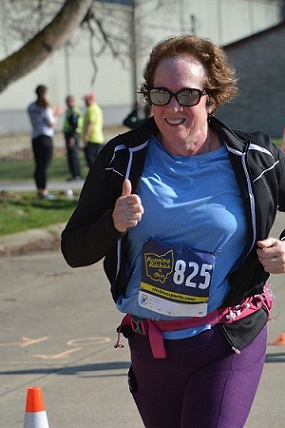
Last week I ran the 2019 Hop for Hope 5K. This is getting to be a tradition. It’s April 2019 and I ran my first race of the year. I’ve run this race a few times which I wrote about last year. It also seems to be a tradition that I’m not feeling prepared for running the race. I suspect that’s because it’s April and early spring in Ohio.
Quick recap of the race. I would say fewer people signed up for the race this year. This could be due to a few other 5/10 Ks going on in the area on the same day. It was a beautiful spring day with perfect temperatures for running, about 50 degrees Fahrenheit. It was sunny and dry. Really, it doesn’t get much better than that, does it?
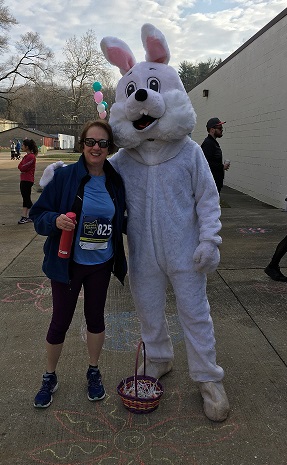
The Easter Bunny was on site and after the race, the kids had an Easter egg hunt. They also put some golden eggs along the course for adults to win prizes. I knew I would never spot a golden egg because I was too far back.
Despite not having run 3 miles in a long time, I managed to run the 5K without having to walk or stop for a rest. I think this is where experience comes in. I knew I had run this before and managed to pace myself enough to finish the race running. I’ll be returning to my Couch to 5K app now and continue with my training.
I did some stretching before and after the race, trying to avoid any problems with my ankle or my piriformis muscle. That must have worked because I didn’t have pain the next day, which is a sign of success.
We got a great long-sleeved shirt this year and of course everyone who ran received a medal. Their rabbit logo is getting pretty hip these days.
I enjoy running and I like participating in races because they’re fun. There’s something about having official times that also spurs me on to try harder. On the other hand, running has caused me the most problems with my body and I need to pay attention to that.
So, how did I do? I ran the race at about the same speed as last year. I know that because Strava told me. Don’t you love technology? I was uncertain last year about how I’d do, much like this year, so I’m glad I stayed at about the same spot. They didn’t do age group winners this year but a quick look at the results list showed me I would have been second or third in my age group. Nothing to get excited about. Of course, I didn’t run it thinking I’d be fast.
I will continue to cross train with strength training and including yoga in the mix too. Strengthening muscles and tendons is important and working on flexibility and balance is critical. I’m going to also continue to run using my Couch to 5K app. I’m on week 5 so about half way through. I’ll keep you posted on how this goes. It’s so much more enjoyable to be able to run outside and get off the treadmill or an indoor track.
I’m already thinking about signing up for another 5K in a couple of weeks. What’s your plan for the next few months?
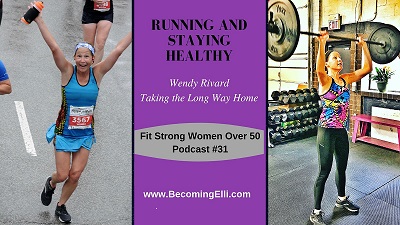
In episode 31, Jill and Chris talked with Wendy Rivard about her fitness journey.
Wendy has been a runner for most of her adult life. She is a pediatric nurse practitioner for a large medical practice in Chicago. Besides running, she does a lot of yoga, strength trains at a Cross Fit box, enjoys boot camps, water skiing, stand up paddle boarding, and kayaking.
She started running to help deal with anxiety in her 20’s, and continued running to help with other life challenges: infertility in her 30’s, stress of grad school in her 40’s, and now in her “old age”, she continues to run to help her stay healthy.
In 2014, she achieved a personal record of 4 hours 17 minutes at the Chicago Marathon at age 52 using a low mileage training plan with lots of cross training. Her bucket list marathon was Big Sur which she completed in 2016.
Her most recent half marathon was in Mobile Alabama in January, home of the original mardi gras. She met up with several bloggers and ran through the beautiful neighborhoods with the live oak with moss hanging down over the streets. The finish line featured women wearing the southern belle dresses with hoop skirts greeting the runners with their finishers’ medals. Red beans and rice was served with a dixieland jazz band party after the race.
She writes about her journey at the Taking the Long Way Home and has made many running friends online and in person through the blog.
We discussed:
Her cross training as well as events like the indoor relay, Ragnar, half marathons and marathons.
The benefits of the therapeutic massage and how it differs from a regular massage. Other recommendations for recovery.
Loves the Ink n Burn clothing because of the wild colors and the pockets. She was a brand ambassador. https://www.inknburn.com/ladies/
Her diagnosis of Rheumatoid Arthritis two years ago and how she is learning to live with it and refuses to let this disease defeat her.
“It’s not the running that hurts the joints, it’s the arthritis.” She has cut back on some running but has added more strength training to support the muscles around the joints.
How to contact Wendy Rivard:
Find her at www.takinglongwayhome.com Instagram
Also mentioned in the podcast:
Marcia from Marcia’s Healthy Slice
Holly from Ho Ho Runs
Deana Kastor: Let Your Mind Run: A Memoir of Thinking My Way to Victory
Since I’m trying to do a new veggie each week, I’d be remiss not to talk about the Dirty Dozen and Clean Fifteen.
Although this has been a thing for a while, I’m still trying to get on board. The “dirty dozen” and the “clean fifteen” are ways to deal with the about pesticides that are so difficult to wash off of the fruits and vegetables. These guidelines (which basically is just a list of foods) are a great place to know when to buy organic and when it is safe to buy regular.
Today’s post was prompted by a recent food report that found some multiple samples of kale with 18 types of pesticide residue. Yikes! And kale is listed as number 3, meaning strawberries and spinach are worse offenders.
This list of dirty dozen is actually what I call a baker’s dozen with 13 different fruits and vegetables
The dirty dozen are the fruits and vegetables that have too much pesticide residue, washing doesn’t remove it and buying organic is a better solution. The clean 15 are okay to buy non-organic.
Dirty Dozen (buy organic)
Strawberries
Spinach
Kale
Nectarines
Apples
Grapes
Peaches
Cherries
Pears
Tomatoes
Celery
Potatoes
Sweet Bell Peppers
Clean 15
Avocados
Sweet Corn
Pineapples
Sweet Peas Frozen
Onions
Papayas
Eggplants
Asparagus
Kiwi
Cabbage
Cauliflower
Cantaloupe
Broccoli
Mushrooms
Honeydew Melons
I live in an area that has many choices of fruits and vegetables year round. And it’s not always apparent which ones to buy. Just like most things, price is one of the biggest factors. But now, as I continue to commit myself to getting fit and strong, keeping poisons out of my system has become more important.
It’s hard to realize the huge role pesticides play because it’s very cumulative.
Animals eat treated food. Genetically modified foods have some sort of effect. Pesticide residue is difficult to remove from some foods. I try not to be crazy about my food, but even if this was exaggerated and there are only 4 types of pesticides, that has got to do something to my body!! (Some of the grapes and strawberries I have seen in the stores are two or three times the size we grow at my house!)
Okay, so if you have trouble remember which fruits and vegetables are on which list, you may download this list of the Dirty Dozen and Clean 15 I typed up for myself. It is not a PDF, it is in Word. That way you can change it around as suits your shopping list! On my personal shopping list, I like to highlight what I’m going to buy. Either way, you can also cut out the list of the Dirty Dozen/Clean 15 and carry the little chart when you’re shopping.
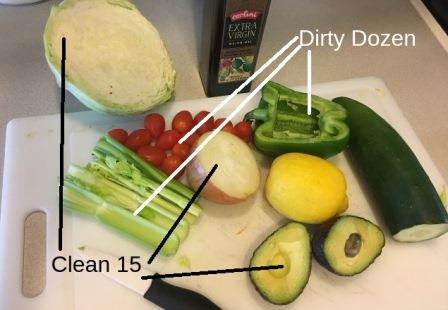
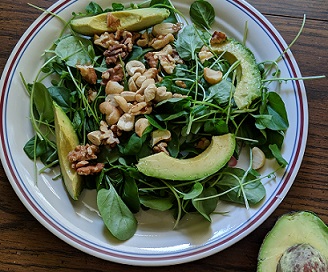
The photo I used was from a salad I had a few weeks ago. (Full disclosure, the only thing I bought organic was the avocado because they were ripe. But I’m trying to do better.) Notice the cucumber and the lemon didn’t make the list. Although I’m guessing it would be better to peel the cucumber and not zest the lemon. Just guessing here.
Do you follow the Dirty Dozen/Clean 15 recommendations? Do you have a good way to remember them? Maybe a little song or something?
Watercress is a green that can be used in salads, sandwiches, soup, and anywhere else where you might use arugula, spinach, and other greens.
I just recently heard what a nutritional powerhouse watercress is so thought I’d give it a try. I found it at a local grocery store in a plastic tub similar to what the other greens I buy come in. The watercress that I bought was grown locally. Given that I bought it in March, it must be grown hydroponically or in a green house. There are no greens growing in fields in northeast Ohio this March.The cost was comparable to buying baby kale, spinach, and spring mix.
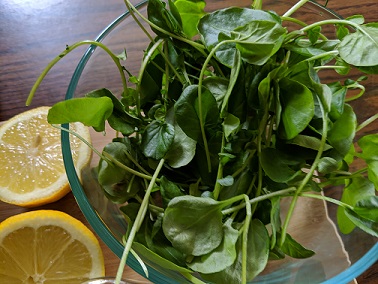
I liked the flavor of watercress. It’s has a bit of a bite to it, though not as strong as arugula. It’s good. It stands up against other flavors without being overwhelming. As you can see in the photo, watercress has long stems on it. Recipes all said to remove stems, at least the thick ones. That is a long, slow chore so I sort of skipped it.
According to the USDA food composition datatbase, watercress is very low in calories. Actually, it’s very low in fat, protein, and carbohydrates so you can eat a lot of watercress. It has a lot of vitamins and minerals, including potassium, Vitamin A, Vitamin K, and calcium.
Watercress Salad
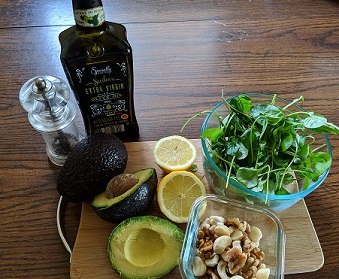
Here’s a salad to make with watercress.
Ingredients
juice from one lemon
1 T minced onion
3 T extra-virgin olive oil
salt and pepper to taste
1/2 cup raw mixed nuts
1 ripe avocado, peeled and cut into wedges
4 cups watercress, thick stems removed
Directions
Preheat oven to 350.
Salad Dressing: Mix lemon juice and minced onion. Whisk in olive oil and season the dressing with salt and pepper.
Spread mixed nuts on a baking sheet and bake in oven for about 5 to 7 minutes. The nuts should be golden brown and fragrant. Watch them carefully so they don’t burn. Let the nuts cool and then chop them coarsely.
Salt the avocado wedges.
In a good-sized salad bowl, toss the watercress, nuts, and salad dressing until coated. Add the avocado wedges. Serve immediately.
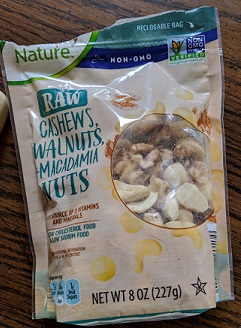
Note: You can use one type of nut. I had the raw mixed nuts that contained walnuts, cashes, and macadamia nuts so used that.
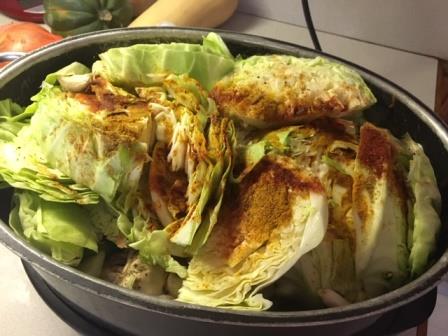
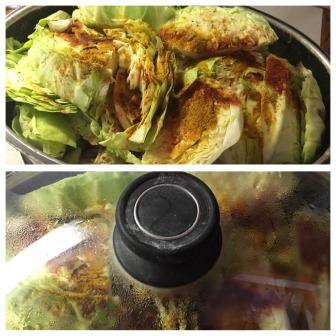
Today’s Veggie Challenge recipe is an easy one! Add a little water to the bottom of the crock pot with two teaspoons of olive oil. Chop up two cabbages and place inside the crock pot. Sprinkle liberally with ground cayenne pepper.
Put the lid on and cook on low for about 4 hours. Stir after a couple of hours if you are home.
This makes a great side dish. The spicy ground cayenne pepper gives a kick to the smooth texture and flavor of the spicy cabbage.
When spring rolls around I start thinking about riding my bike outside. For me, happiness is bike riding.
It reminds me of when I was 10, 11 and 12 years old. Lots of good memories of riding bikes as transportation to go visit friends, using the construction site around the corner as my personal BMX course, and having freedom to go where I where ever my bike could take me.
Just seeing the weather get a little more sunny and a little less cold has me thinking about bike riding.
Doing something you love, that just happens to help you get fit, is a real lucky thing, I think! This time of year is full of anticipation for me.
I’m going to do a big ride in August as a fund raiser and my team will begin riding soon, I’m pretty sure. Before that, I’ve got a checklist:
The bike itself:
handlebar tape
chain
tires
tubes
rims
brakes
shifter
Bike gear:
spare tube, co2 and tools
rain gear
shoes
bike pants
light
reflector
water bottles
helmet
snacks
sunscreen
phone rain protector
bike gloves
I’m going to be gathering my equipment and checking out my bike. Now that the sun sets well after 7 pm, it gives me a chance to get a little riding in after work!
Do you enjoy bike riding? Does it remind you of your childhood? If you’re not a bike rider, what do you look forward to in the spring?
Recently, I did my first triathlon of any kind. I was nervous about it, mainly because I thought it was likely that I’d not be able to finish it. Fortunately, I did finish and ended up being happy over the results.
Indoor Triathlon Set Up
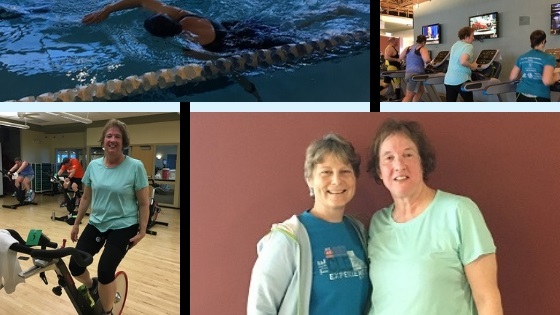
This indoor triathlon was set up for:
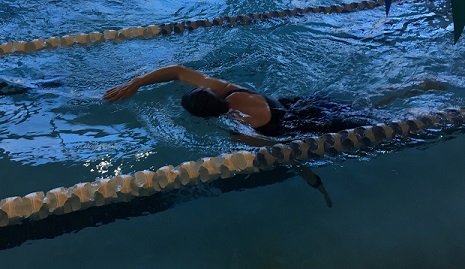
10 minutes swimming in a lap pool
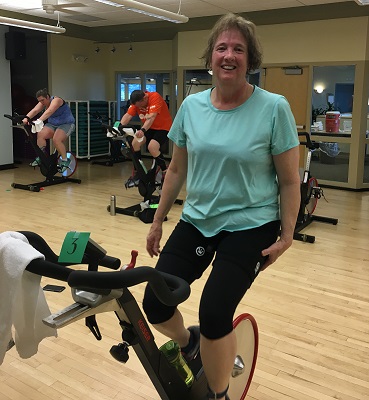
25 minutes riding a stationary bike
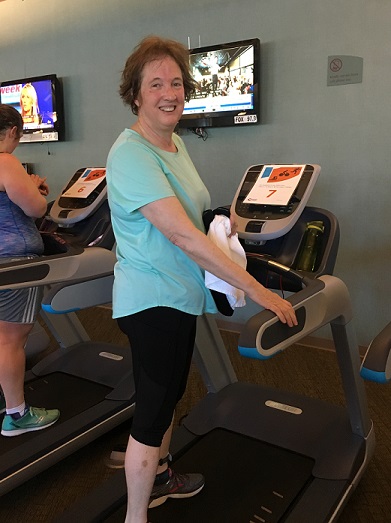
20 minutes running on a treadmill
Indoor triathlons are probably easier than outdoor ones because the swimming is in a pool instead of open water. There are no issues with weather or having to figure out where you’re going. Also, it’s a great advantage to be able to kick off from the wall every time you turn direction in the pool. The bikes are easier because you don’t have to watch the road or deal with hills. Same with the treadmill. You just set it to the speed you want and there you go.
The pool is a 25 meter lap pool. There were four lanes in use and most of the lanes were shared by participants.
The bikes were in a studio class room, so we were isolated from the rest of the gym. Music was playing and people were cheering each other on. It was a fun, supportive atmosphere.
The treadmills were set up in the main cardio area of the gym. No special music was playing and I had not thought to bring my headphones. My fancy AfterShokz Trekz Air bone conduction headphones were sitting in my gym bag so they were on the premises but no time to get them. So, no inspirational playlist for me! Also, the TVs were on and not set to anything special. Sunday morning TV is not conducive to much, if you ask me.
My First Indoor Triathlon
I was nervous about doing this indoor triathlon because I only started training a short while ago. I’ve spent a few months dealing with piriformis and sciatica problems. In other words, I’ve had a lot of pain in my lower back, right hip, and right leg. Once it began to clear up, I started training again and then decided I’d do the indoor triathlon. Just to be clear, I was pretty active before this hip/lower back issue flared up and managed to do some exercise while dealing with the pain. I just wasn’t in competitive shape, I’d say.
Things I kept saying before the race were
“I don’t know what I was thinking.”
“I’ll probably be last in everything.”
“I probably shouldn’t be doing this”
Where were those positive thoughts I’m supposed to be saying to myself? I guess I still need to work on that.
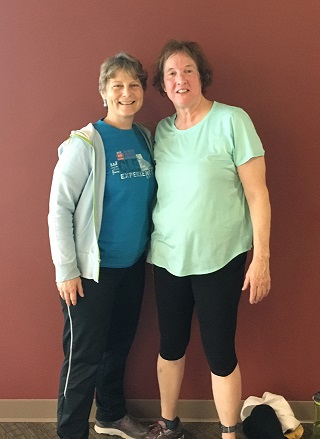
Chris came to take pictures and cheer me on. What a great friend! Having someone encourage me really helped.
Of course, you know how this goes. I ended up being very happy with my results even though I was pretty close to being last in everything. My performance was better than I expected.
Swim
I managed to swim the full 10 minutes without too much stopping though I really became winded during the swimming. Having to share a lane was challenging. Also, being a in a pool full of people trying to swim quickly makes for much more turbulent water than usual. I’m not used to thinking about speed when swimming, so I was glad to be able to put my feet down and take a quick rest at the end of a length.
Bike
The bicycling wasn’t too bad. I knew to set the resistance at a high enough level so that I’d get some mileage. I’d heard stories about people setting the resistance to the lowest level and then pedaling like crazy only to end up with very little mileage. I tweaked the resistance occasionally during the ride based on how I was feeling and how much time was left. Having music and being able to encourage each other was great.
Run
Running surprised me. I’ve been doing my Couch to 5K app and so hadn’t run for any consistent time for several months. I didn’t go for speed, but I did manage to run the 20 minutes with only two walking breaks. I was on a treadmill between two young women and was able to keep an eye on what they were doing. One ran at a faster speed but walked more frequently. The other was running at my speed or slightly higher. I liked not feeling like a true slow poke. We all ended up with very similar mileage by the end. I know we’re not supposed to compare ourselves to others, especially people a few decades younger, but it was a race, you know?
Transitions
Let’s not forget the transition times. Those are the periods of times between events where you get ready for the next one. We had ten minutes to get out of the pool, change, and get to the bikes. Between the bike and run, we had five minutes. Handling transition times in any triathlon is a challenge.
Here’s what I learned. First, it’s really difficult to get out of a bathing suit and into biking and running clothes quickly. I got stuck trying to put on my sports bra because my skin was damp. A woman in the locker room helped me get it down my back. Lesson learned: don’t wear a pull-over sports bra. I see why the outdoor triathletes wear clothes under their bathing suites.
I forgot to use the restroom during the initial transition time because I was hurrying to get to the bike. So, when I got to the second transition, I ran to the restroom, hoping to avoid a line. Success! but then I had little choice on treadmills so ended up with one that was between TV screens set to Fox News and ESPN. I really missed my headphones.
My Results
By the time I finished, I was sweaty, tired, but also exhilarated. Hooray! I completed my first indoor triathlon. Success!
Chris spent the whole event cheering me on, taking photos, talking to people and encouraging them too. She made the event even better.
Results weren’t released until later that evening. I received an email with a copy of the spreadsheet.
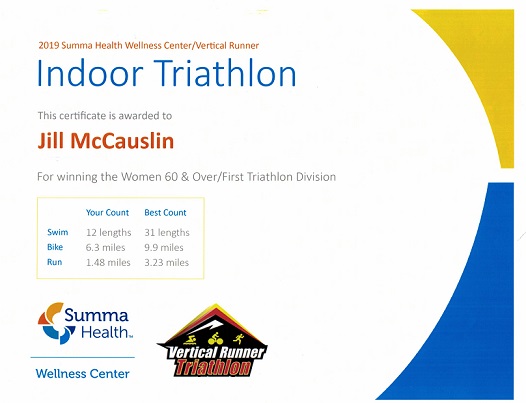
Here’s how I did:
Swim 10 minutes: 12 lengths
Bike 25 minutes: 6.3 miles
Run 20 minutes: 1.48 miles
I won for my age in the first triathlon division. Pretty good! Well, you know there weren’t many women who fit in that category but a win is a win, I guess.
There was someone in the locker room to make sure we knew how much time we had and that everyone found their way to the pool and the bikes.
Having a monitor and music in the bike area was great. I h getting my bike set up and appreciated having someone there to show me the way to work the bike.
I think the only negatives that I had were the TVs on talk programs in front of the treadmills and no music in the running area. Or, I wish I had realized I need my headphones.
The price of the race was low. As a result, there’s no shirt or whatever, but we did get a fantastic USB-chargeable bike light. That’s something all triathletes can use. The man organizing the race said it’s a great event for first-timers, so he likes to keep the price low to encourage them to participate. That’s a good goal.
Overall, it was a great event and I’m likely to do it again next year.