This week was a vacation with my family at the beach in North Carolina. Each day I tried to make sure that I got at least my 75 minutes of some sort of activity each day.
It was definitely different being away from home!
This past week I did a variety of exercises… mostly beach walking, but also beach yoga, and swimming in the ocean as well as the pool.
Getting a lot of fresh air and exercise was good for my sleeping.
I did not do as well as I usually do with healthy eating habits including ice cream, brownies and splitting a fried seafood platter! Now that I’m back home, that’s okay, life will be back to normal next week.
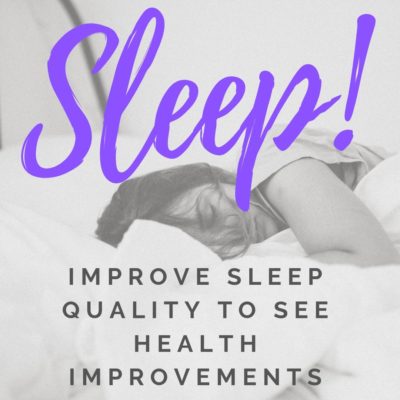
Typically we don’t think about sleep, or the quality of sleep when we talk about being fit and strong, but obviously sleep is critical for health and fitness.
Not having good quality sleep at night will just about guarantee a cranky day for me. Everything seems like a chore when I’m tired.
I am the type of person who falls asleep quickly but sometimes can’t stay asleep. It seemed to start for me in my 30’s, after children were born, but became more difficult to manage after I turned 50.
Since then, I’ve read several books about it and have gathered lots of helpful ideas on how to improve the quality of sleep. I imagine there are other fit, strong women over 50 who also struggle with this, so I thought I’d share some of the ideas here on Becoming Elli.
My personal goal is to get seven and a half hours of sleep each night. Sometimes I may have to spend up to 9 hours in bed to accumulate that much sleep. I tend wake up often, sometimes just for a minute, sometimes for 10 minutes or longer.
Sleep Stages
You probably know that there are different stages of sleep each night, and that each stage serves a different purpose.
Deep sleep usually happens earlier in the sleep cycle and helps the brain to be cleared of toxins. With deep sleep you typically don’t remember sleeping and time seems to go by very quickly.
Light sleep is the stage of the majority of sleep and you may awaken several times in this stage. A lot of tossing and turning during the night might be considered light sleep. Light sleep is still important for your body to refresh and rest. Light sleep is often the majority of the sleep time and usually in between going to sleep, deep sleep, REM sleep and waking up.
The third stage is REM sleep – Rapid Eye Movement. This is more typically considered the dreaming sleep. It is usually toward the end of the sleep cycle. Waking up with an early alarm may interrupt your REM sleep and that’s why you might remember a dream so vividly. REM sleep helps you make sense of the world, organize memories and deal with emotions. The brain is very active during REM sleep but your body has temporary muscle paralysis so you don’t act out your dreams physically.
I crave at least 60 minutes of deep sleep. I have found the only way to ensure that is an “early” bedtime. If I go to bed after 11, I can’t make up the sleep on the other end, even with sleeping in, so I strive for 9:45 at the latest.
According to the chart on my FitBit, it’s not unusual for women in their 60’s to spend more than 16% to 27% of the night awake. That seems like a lot of waking up to me. I have an average of 14% awake and a 7 and a half hours asleep average going for the past 30 days.
Overall, I find it’s easier to get my sleep in the winter because its a little colder and a little darker than the summer. Being more active in the summer helps me to counteract the shorter and warmer nights.
My FitBit also counts the time I lay in bed awake before falling asleep and after waking up but not getting up. I try to get up at least 3 minutes after waking up if possible. While I like checking the stats on this monitor, it’s really about how I feel both mentally and physically that makes a difference to me.
There are lots of reasons people have a difficult time with sleep. If you have trouble sleep ask yourself these quick questions to see if you have room for improvement in your sleep hygiene behaviors.
Take this Sleep Hygiene Quiz
Do You:
Avoid naps in the afternoon or early evening?
Follow a 15 or 20 minute pre-bedtime ritual?
Limit screens 1 hour before bed?
Stop drinking caffeine? (or eating chocolate) early in the day
Only use the bedroom for sleeping? (not eating or watching TV)
Get your exercise earlier in the day? (not right before bedtime)
Keep your bedroom dark and quiet?
Practice meditation, deep breathing or a warm bath before bed?
Go to bed at the same time each night?
Some people who have trouble falling asleep may also have trouble staying asleep.
Here are two ways that I find helpful to get back to sleep if I wake up and don’t fall right back again.
Relaxation Breathing:
The first one is Yoga inspired. It’s a deep breathing exercise, described by Dr. Andrew Weil. It’s called 4-7-8 breath where you breath in your nose for a count of 4, hold for a count 7, and breath out your mouth for a count of 8. He explains it at length in an audio book called Breathing: The Master Key to Self Healing. (Yes, it’s a 2 hour listen with lots of background information and a guided workshop.)
Dr. Weil teaches this technique to all his patients, other doctors and just about anyone who will listen. He considers this breathing technique to be the one thing that everyone should do for optimum health.
Body Scan:
The other technique I use to improve sleep quality and get back to sleep quickly is a body scan from toes up. There are many apps that offer a guided meditation way of doing it. If you listen to one of them a few times, you’ll get the idea, but it’s best to do it just in your own mind.
This website shows a script that you could record for yourself. The advantage of listening to a calm voice that prompts you what to do helps keep your brain from having to think and relax at the same time. I like to start from the toes up.
When we talked about this in our recent podcast (#34 Improving Health with Training, Sleep and Omega 3), Jill said she also would do a modification of the body scan technique for her young son when he had trouble sleeping. She suggests tightening each section and then relax it for a better effect. I bet that would work well, too!
I really focus on improving sleep quality to get a good night sleep after weight training and working out because I know that it is an important part of recovery. This is when the little muscle tears during exercise during the day gets repaired. The new muscle growth happens with blood flow to muscles helping for muscle coordination, improve reaction time and rebuild the muscle. Sometimes this takes two days after a really hard workout. Not getting enough sleep at this time can lead to problems like hormone imbalance, bad mood, additional stress, difficulty concentrating and slow muscle repair.
Sleep is very important for memory, concentration and focus, learning and overall health.
Do you have trouble with sleep? What have you tried to improve sleep quality? What works? What DOES NOT work!? You can leave a voice message at 330-970-6662 or send me an email at Chris@BecomingElli.com. I’d love to hear your thoughts.
Running after injury is a challenge. Since I’ve been working on getting back into running shape after having a year of aches and pains in my ankle and hip, I thought I’d give you an update.
I’ve finished week 8 on my Couch to 5K app, with only one more week to go. I’m no longer doing a walk/run training but instead am running for an extended period of time. For my most recent run, I ran for 28 minutes and other than slowing down to adjust my music, I managed to do it. The app takes me to running for 30 minutes so I guess we know where week 9 ends up.
It was a challenge, especially because I ran on a rather hilly course. Lots of huffing and puffing going up hill but I survived.
I’m improving my cardio vascular system, that’s for sure. I can tell that my recovery is pretty rapid.
I notice some twinges with my Achilles tendon and with my piriformis muscle but nothing too severe. I’m trying to proceed slowly enough that I don’t have any significant pains. My goal is to acclimate my body to running again and avoid injury. After each run, I use my lacrosse ball and roller and try to get in my stretches.
I’m not sure how slowly I need to increase distance or speed but I think I’m going to aim for the ability to run two to three miles a few days a week. If I can do this for a few months, then I can think about running further.
Another 5K would be a great goal. Signing up for a race is a great way to motivate me for training. I’m so much more motivated to train when I know that I’ve made a commitment to an event, especially when I’ve paid for it. Isn’t it amazing how putting money down for a race really makes one feel committed?
In order to prevent additional injury, I’m making sure to cross train so I’m not feeling to compelled to run more than three or four times a week. Twice a week, I try to do some weight lifting and then end each week with my boot camp class. I also try to incorporate yoga into my routine. I talked more about this in our most recent podcast so be sure to check that out.
If you have some experience with coming back from an injury, please share it in the comments.
In episode 34 of the Fit, Strong Women Over 50 podcast for the Becoming Elli community, Jill and Chris discuss a variety of ways for improving health.
Improving Health
There’s more to becoming like Elli than we like to think. It’s not just eat vegetables and get 10,000 steps a day. Jill and Chris cover some of the other aspects of being fit and strong. They discuss:
their training this spring
problems that arise with sleep and how to avoid them
the importance of including Omega 3 fats in the diet
Chris and Jill discuss how they’re training for progress into summer and how they’re dealing with or avoiding injuries. Biking, running, yoga, and strength training are the major forms of activities.
Chris is also giving back to the running community by volunteering at aid stations for a variety of races.
Sleep
Chris explains:
why sleep is so important
why it can be difficult to fall asleep
how to improve sleeping habits
She also discusses some new research about how our body “cleans” our brains while we sleep.
Jill discusses why it’s important to have Omega 3 fatty acids in your diet and ways to increase your consumption of Omega 3s. This includes using supplements such as fish oil or krill and foods that are rich in Omega 3s like salmon, sardines, and walnuts.
Regular readers may have noticed that I have missed posting lately. I guess the main reason is that there has been a loss at my house. I’ve really been missing our 14-year-old dog Lucky, since he has passed away May 14.
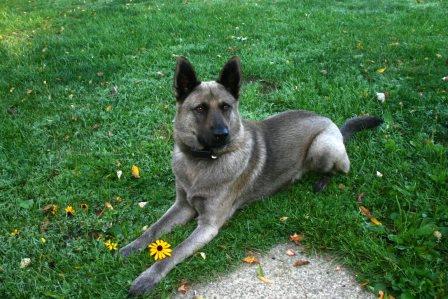
Lucky posing October 2008
Obviously the loss of a pet doesn’t compare to the loss of a human loved one, but to deny those emotions doesn’t make them go away. If you’re not a dog lover, you may want to skip this post and check out some of our other ones.
Lucky with Jean at Bow Wow Beach years ago
You probably recognize Lady, but I’m not sure I’ve put any photos of Lucky on Becoming Elli because he really hasn’t come on a lot of walks during the last few months. I used to do many many walks with Lucky. He loved getting the miles in and only seemed to get tired in the heat, I think because of his double coat.
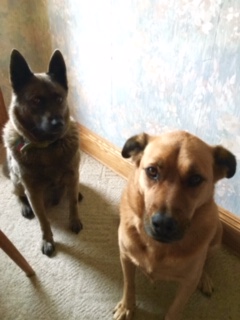
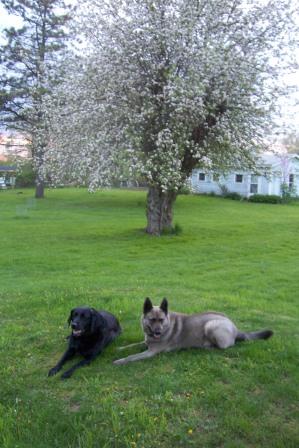
Lucky on the left, Lady on the right.
We got him at just a few weeks old when the mother dog abandoned the litter. He had his own independent personality. Lucky loved chasing a tennis ball, swimming at the dog park and chewing on a good bone.
Lucky and Kingsley
Obviously he was a mixed breed, and although I think his mother was part German Shepherd, he seemed like he was mostly Norwegian Elkhound.
Lucky at age three (right) with Jean in May of 2008.
Like most pets, he definitely become part of the family. All of my pets seem to really wiggle their way into my heart and I talk to them like they are people.
Lucky and Lady at Christmas time a few years ago. I took them for a walk downtown and logged just over 5 miles that day. It was unseasonably warm for December.
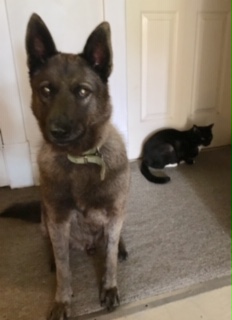
I think Lady and the two cats, Kingsley and Sasha, have gotten so much more attention since Lucky is gone. He required quite a bit of care the last few months.
This is supposed to be me, dressed as Kingsley for a Saturday Smile – illustration credit Bitmoji.
While Lady doesn’t appear to be missing Lucky, I can’t claim to know what is in her mind. I believe she is enjoying the added attention and dog walks.
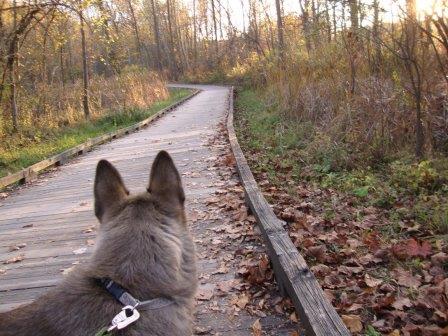
Lucky on the towpath in the fall. I remember this day because it was a 6 mile walk and I was amazed when I looked at my tracker when we got home.
Walking with a dog really takes my mind off of the time and effort it takes to get exercise.
The other day, during one of our recent walks, I figured out that Lady is my age in dog years! I’m doing my best to enjoy being with her and getting more walks. Good-bye Lucky dog…
Linda started running in 2011 and has a group of friends that call themselves the 50+ Posse. She gets up early in the morning to workout.
Around 2015 she started bicycling. She was active in the Slow Roll bicycling group in Cleveland that meets every Monday at different locations to ride through the city for about ten miles. It is good for beginner bike riders because the group rides slowly. Other cities also have Slow Roll bicycle clubs.
Linda retired in December 2015 and started swim lessons in January. She progressed quickly and was swimming the length of pool by May. By winter, she had already logged in 100 swimming miles. Now she swims for two hours, once she’s in the pool.
She is very real in sharing her story about becoming a triathlete after retirement.
Although she has had lupus for 16 years, she doesn’t “claim it.” Linda changed her diet to avoid foods the doctors said would trigger joint pain, took the medications that they prescribed for her and became very active.
Her first triathlon experience was in January 2018 at the Twilight Tri in Cuyahoga Falls, Ohio. She enjoys indoor cycling at the Cycle Bar in Hudson.
Motto for the biking groups that she belongs to is “No One Left Behind.”
Links mentioned in this episode:
Black Girls Do Bike https://www.blackgirlsdobike.com/
Slow Roll Cleveland http://slowrollcleveland.com
Black Girls Run https://blackgirlsrun.com/
Member of Cleveland Triathlon Club. Trains with them. https://www.clevetriclub.com/
She uses the runkeeper phone app: https://runkeeper.com/
The Great Ride https://www.wqed.org/ride movie about the Great Allegheny Passage (GAP) trail and the C & O bicycle trail that features members of the Black Girls Do Bike group.
Maps and info about Bike riding in NE Ohio, Cleveland and Akron : http://www.bikecleveland.org/wp-content/uploads/2015/03/Bike-CLE-spreads_bleed-no-marks.pdf
NE Ohio Bike trails: https://www.ohiobikeways.net/neregionlist.htm Akron: https://www.ohiobikeways.net/akron.htm
Cleveland: https://www.ohiobikeways.net/cleveland.htm
Do you take the stairs or the elevator? The thing I like about stair workouts is that the act of climbing stairs is so practical. What I don’t like, well the huffing and puffing when I haven’t been doing it.
It’s easy to feel like you’re making progress when there are stairs that make you huff and puff. And then a few weeks/months later, you notice that it doesn’t even effect you at all to go up the stairs.
When I was actively trying to lose weight, I felt a huge “non-scale” victory when I realized that I just had run up some stairs without even thinking about it or realizing that I ran up them.
Some friends of mine went on a major hike last summer to the White Mountains on the Appalachian Trail. Some of them practiced on these stairs in the Cleveland Metroparks that over look the Rocky River.
There are several reasons why a stair workout is a good idea:
Stairs are good for you
You can build up to them
Stairs or steps are everywhere
Stairs work the glutes, hamstrings and calves.
They provide a great feeling of accomplishment
It’s natural workout, not something that you don’t do in real life
Things to be cautious about:
If you wear eyeglasses with progressive bifocals, try not to look down when you walk down
It’s fair to use the hand rail, in fact a good idea. You don’t want a “quick trip” down or up!
Your heart will really start to beat quickly. On the way up, it’s okay to pause on a landing to catch your breath.
It’s a good idea to step aside, if someone is behind you to let them pass.
Don’t try to do it all at once, better to build up your stamina over time.
From age 35 to 50 I was definitely an elevator taker. I often looked for an elevator. If there was no elevator, my attitude was “oh boy, here we go!”(not in a good way.) It wasn’t until I turned 50 and decided I was going to get into shape that I embraced the stairs.
At first when I turned 50, I decided to get started on the Stairmaster at the gym. That didn’t last long. I found it was too boring and too much effort to get dressed in my workout clothes, drive to the gym and then only be able to accomplish 5 minutes or so on the Stairmaster. Of course, I put it on the highest level. Not the best idea.
I found better success by using stairs right near me.
Taking the three flights of stairs everyday in my office building became part of my new routine. I would park in the spot farthest away from the door and then take the 3 flights up to the office. If I was going to use the restroom, I’d go to the first floor and walk back up to the office. At lunch I’d do another set or two. Soon I was doing about 15 flights a day.
I got the idea because I used to regularly do 12 floors in college. The Kent State library was the tallest building around at 177 feet. Every day I’d walk by the library several times between classes and my dorm. After a while, I’d just walk in and do the stairs. After a while, I could do all 12 floors. Not a big deal in my late teens and early 20’s. I found that it was a great stress relief.
Of course, I’m not always near a tall building, but one set of stairs still works. I live in a one story house and the laundry is in the basement. My FitBit has a 10 floor goal. Okay, I’ll agree that is a lot of laundry to do each day, but I have found that just loading the washer is one, switching to dryer is two and bringing up from the basement is three. So, if I turn around and go up and down two more times for each one trip, I can just about get my goal pretty easily. Plus clean the cat box each morning which is also in the basement. And boom, I’ve got my 10 stair steps.
Where are stairs near you? Do you use them to do a “natural” work out?
I recently had a trial class here in my town, at a relatively new exercise studio called Club Pilates.
While over the years, I have taken a few Pilates classes at the health and fitness center where I’ve belonged almost continuously since 1994, it’s hard to pass up a free class to check out something new.
Regular readers may remember my CycleBar experience and Jill’s workout at this Pilates studio when it had just opened.
Sample Class
I got a ticket to a sample class during one of the community expo/showcases held locally. The Club Pilates runs a special 30 minute sample class for a group of people who have expressed interest. There were 8 people in the class, including me.
Facility Set Up
The facility location is in shopping plaza. The exercise room is set behind the front desk and has a wall with curtains to separate the waiting area from the work out area. You put your personal items in open faced wooden cubbies that are located up in the front. Because a curtain separates the front from the workout area, I wouldn’t be able to keep an eye on them, so I ended up keeping my phone and keys with me in the work out room.
Each personalized station is set up for one person. And I believe that there were 12 stations in the club.
Instructor
Our instructor was a former ballet dancer, who was in terrific shape. Unlike many group exercise instructors, he had us do the exercises very slowly so he could monitor and correct our form.
He explained what the benefits to the body Pilates provided and discussed ways to modify the exercises to be more or less difficult depending on each of our fitness level and experience with Pilates type exercises. Because it was only a sample class, he was going easy on us.
Equipment
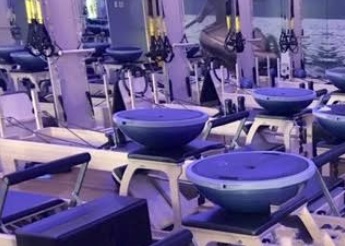
There was lots of very new equipment in top condition. If I wasn’t familiar with it, I might have been intimidated. Among the items at each station was a Pilates reformer machine, bosu, TRX straps with several places to hook them, circle, a small stability ball and a Pilates chair.
The only piece that was new to me was the Pilates chair which looks a bit like a padded bench with springs. They had the bosus sitting on top of the chairs and I didn’t get a great photo of them, but click through on this link to see what they look like and how they work.
They insisted you wear socks with non-skid treads or they would let you buy some from them. I noticed two people wearing some Sky Zone trampoline park socks. I had looked for some of those in the bottom of my sock drawer, but couldn’t find my pair from the time I tried Sky Zone.
Exercises
While the majority of the exercises involved putting your foot in a strap and manipulating the spring under the equipment, many of the exercises were similar to ones that I’ve done in my gym.
Plank – with elbows on the bosu
One foot on the bosu, knee up, balance by touching the wall
Bridge – lying on my back with arms at the sides
Sit on the padded Pilates stool, bend sideways at the hips and press down the spring loaded bar with my hand
The ballet move where you stand and Plié slowly. It’s definitely NOT a squat.
Evidently ballet dancers have issues with squats and prefer the Plié where the dancer stands with the heels together and the toes pointing out, then and bends at the knees.
Individual Training Room
After the sample group class, we were ushered into the back to see the individual personal training area and equipment. There are sales person explained the different membership programs, pricing, requirements and time frames.
I remember she said that they gave a discount to veterans, those in the armed services and to first responders. I thought “Wow, very generous!”
Then one of the women in my class piped up and wanted to know about doctors and nurses as well, “Don’t forget about us!” I don’t know why, but that was a turn off to me. I guess you could make a case for a lot of other professions as well.
During the hour that we were there, that is the only thing that I can remember that any of the other people who didn’t work there actually said. It was a very quiet group.
The biggest positive is the equipment. It looks super brand new like it has never been touched. I believe that the facility opened in September 2018, so it still is very new.
The biggest negative to me is the lack of interaction between the other people. Even though it was a group class, during class it was obvious that there isn’t the joking around. It was very serious and not as much fun.
While I guess I shouldn’t judge the place on how the participants act. Maybe that is how you act during Pilates. However to me if working out isn’t something that I look forward to, I’m not going to do it.
Perhaps I’ll give Pilates another try sometime in the future. Right now it didn’t have the attraction to me compared to so many other types of exercise. How about you? Do you love Pilates? What do you love about it?
Regardless of where you are in your fitness journey, it’s a good idea to track your fitness progress. It can make you feel proud of your accomplishments or make you realize that maybe taking that month off wasn’t such a hot idea.
You may feel like you just know where you are but I think most of us don’t realize how we’re actually doing. This is where it pays off to track your fitness progress.
Take Measurements.
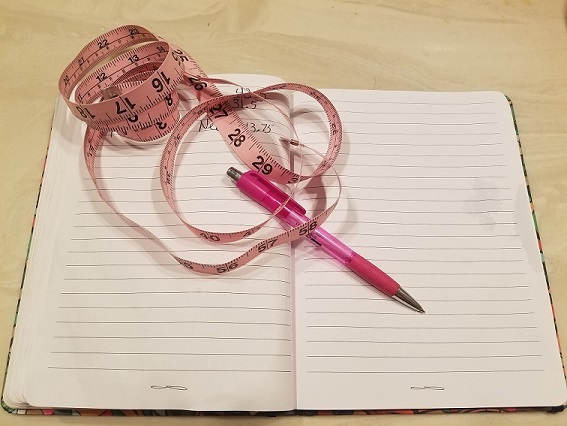
I’ve discussed the value of measurements before. I really like being able to see how I’m doing. I have a journal where I track my weight. I also include my measurements every few weeks. It’s a good idea to get a measuring tape and measure your waist, hips and maybe your thigh. Other parts of your body are difficult to measure on your own but if you have someone to help, you could throw in measuring your chest and your biceps.
You certainly don’t need to measure every day but maybe once a month, look and see where you are. Even changing by half an inch may be a great sign of progress.
This might be where you track other measurements too. This can be numbers provided by your doctor from blood work or tracking your blood pressure or resting heart rate.
Take photos
Many of us hate to have our pictures taken, especially when we’re wearing our workout clothes. I urge you to get over that and take pictures of yourself. If you’re doing a selfie, you want to try to get most of your body in the shot so you may need to use a mirror for the shot.
Save your photos from races and group runs or group fitness events.
Again, photos can be motivating because you may see progress or you may see backsliding. You know that old saying, cameras never lie. Of course that saying is definitely old because now with PhotoShop and filters and everything, many photos do lie but try to keep the originals so you can track your progress.
Write Down Your Strength Workouts
I love weight lifting. If I could only choose one thing to do, I suspect that I would opt to just lift weights. One reason I like weight lifting is that it’s so easy to track your results. Why? Because you’re lifting WEIGHT and it’s easy to measure.
Today I did deadlifts in a fitness class and my max was 105 pounds. Now I know that last year I deadlifted 150 pounds so it’s easy for me to see that I either was slacking today or have lost some strength. I suspect that it’s a bit of both.
If you lift weights, keep track of your sets and what you’re actually lifting. Over time you can see how you’re gaining strength.
Record Weight and Body Fat
This is similar to taking measurements. Jump on a scale periodically. We’ve talked about weighing ourselves every day but many people dislike that. I suggest that you weigh yourself regularly and record it. It’s an easy way to see what your body is doing.
Perhaps more importantly is to track your body fat if you can. I get this checked at my gym every so often using a hand-held device.
Many scales are now available that also provide you with body fat numbers. I know many say that these scales aren’t accurate but I think they’re great for watching trends. As long as you’re using the same scale, you can see if that percentage is going up or down.
Test Yourself
Once a month or so, test yourself. See if you can lift more weight or do more reps in a set. You can do something like set a timer for a minute and see how many push ups you can do. Or you can do the opposite and do 20 burpees and track how much time it takes. If you do this regularly, you will probably begin to see improvements. You might get to the point where you think, “I hate doing 20 burpees” and then you’ll know it’s time to change the test.
Track Your Fitness Progress
It pays to track your progress. Whether it’s seeing that you’re an inch smaller at the waist or that you can do 3 more push ups than you did last month, it’s motivating to know that you’re improving.
Be sure to write this information down because, trust me, you won’t remember the details.
If you’re on this fitness journey long enough, you’ll eventually have photos going back years and that is invaluable.
Let me know if you do any of these things or if you’re going to add them to your routine. I’d love to hear how it works for you.
Snap Peas are crunchy and delicious. Although the peas are inside, you can eat the pea pod as well.
I think their name comes from the way you prepare them. It doesn’t take much. You snap the stem off and pull the thread like fiber that runs down the side of the pea pod to prepare them. I also cut them into four pieces or so to make their size more like a bite size and match the rest of the salad.
I put them in my potluck salad and they added a perfect crunchy texture.
Here’s what is in the salad:
Celery
Carrots
Broccoli
Cauliflower
Blueberries
Yellow peppers
Cucumbers
Olives
Snap peas
Dressing: Olive oil, cider vinegar, and lemon juice. I don’t usually measure carefully, but put enough into the bowl to coat the vegetables without drowning them!
Salt and pepper to taste. I think having it sit in the refrigerator for a few hours made it absorb more of the dressing. The beauty of this potluck salad is that you don’t have to worry about refrigerating it and things going bad. It makes a great salad to put out on the table for the afternoon buffet at a potluck.
Gotta admit I love, love, love this salad! And I think I know why: it has all the taste sensations! Bitter – salty – savory – sweet – sour… Plus zesty, zippy, crunchy, and the blueberries even added a little bit of creamy.
Next time I will consider adding some protein with maybe tuna, walnuts or quinoa.